

The case for banning the burqa
Premium domains for sale
Freedom Is Back In Style

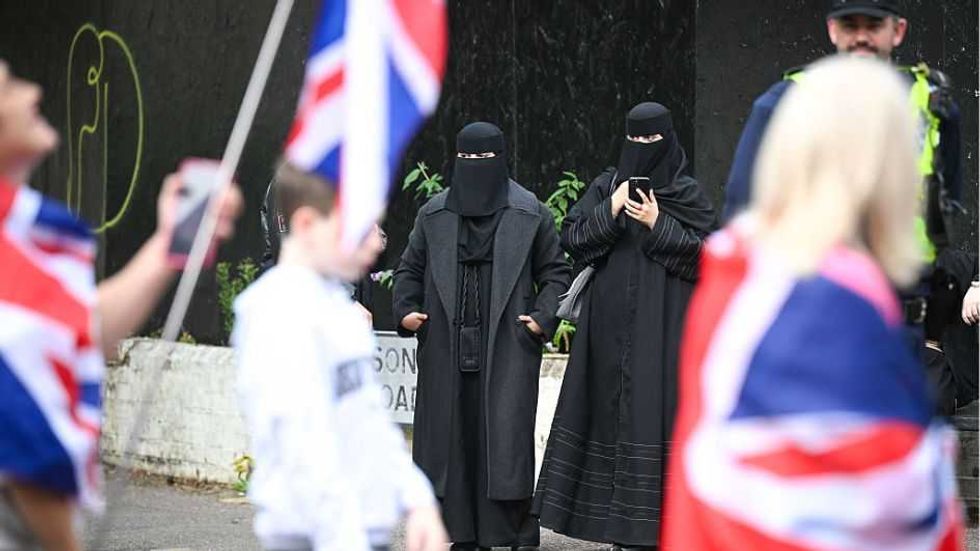
Kemi Badenoch — Conservative Party leader, survivor of the 2024 electoral rout, and arguably the sharpest political mind left in British conservatism — is considering a ban on the burqa as part of a broader review of Islamist extremism.
Freedom Is Back
In Style
Premium domains for sale
She should stop considering and start legislating.
'Freedom' that produces permanent public anonymity for one group, in spaces where no one else enjoys it, is not freedom’s finest hour.
The case does not begin with Badenoch, and it does not end in Westminster. Across six European democracies — Austria, Belgium, France, the Netherlands, Portugal, and Switzerland — full or partial bans are already law.
Their constitutions survive. Their Muslim populations remain. The predicted social cataclysm never arrived.
What arrived instead was policy — enforced and producing measurable outcomes.
Facing facts
The deeper question is why the rest of the Western world has been so slow, so squeamish, to reckon with what the burqa actually does in public space.
Full facial concealment — not the hijab, not the headscarf, but the garment that renders a woman’s face entirely invisible — removes her from the basic grammar of human interaction. Faces carry trust, intention, fear, and consent. Humans have read them for a hundred thousand years, and no amount of progressive goodwill has updated the firmware.
When you cannot see someone’s face, you cannot treat the person as a fully present participant in civic life. You can only treat the person as a shape moving through it.
Free societies depend on legibility among their members. Not total transparency — nobody is proposing to ban sunglasses or launch inquiries into wide-brimmed hats — but the basic mutual visibility that public life requires.
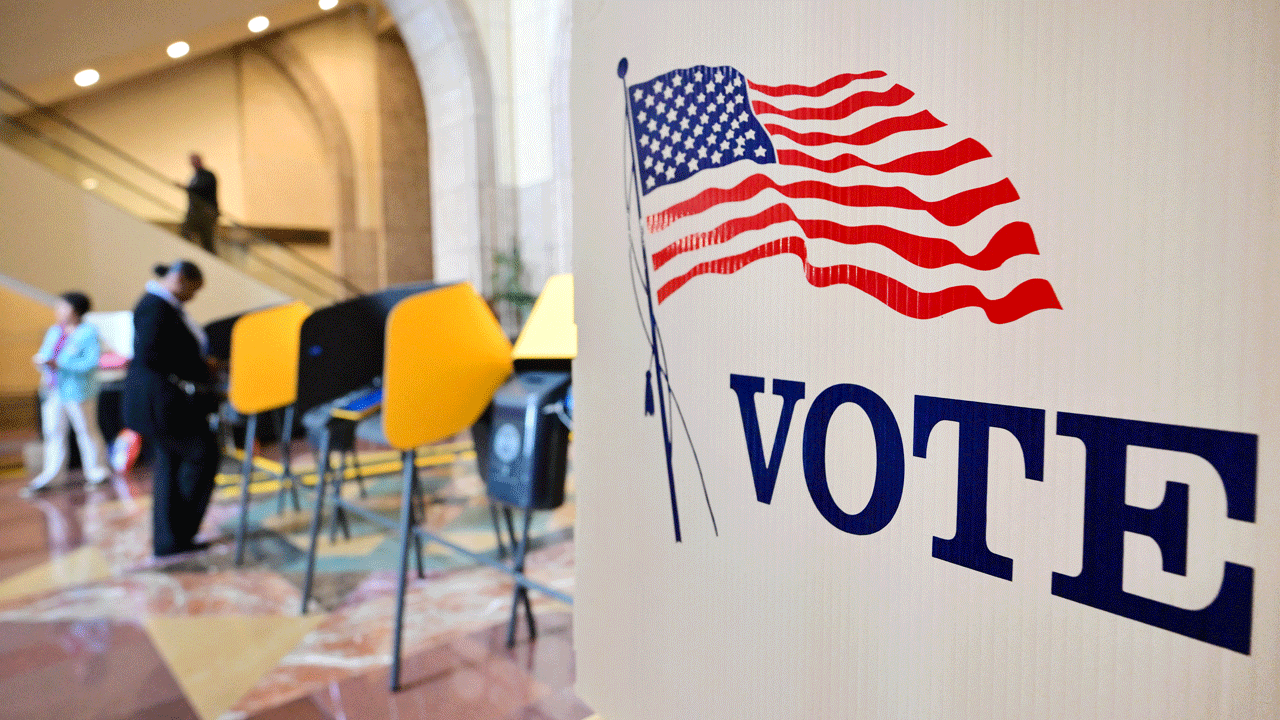
Courts require faces. Banks require faces. Polling stations, airports, and schools all require faces. Nobody marches on these institutions screaming tyranny.
Anonymity in shared space has always carried costs, and open societies have never been shy about saying so.
The burqa asks for a permanent exemption from an obligation everyone else accepts without drama.
Enforced invisibility
That exemption makes a certain grim sense in Afghanistan, where the Taliban reinstated the burqa as compulsory law in 2022 — a country where female faces are treated as a political problem requiring a legislative solution. In that context, the garment is a uniform of erasure, imposed top-down by men who find women’s faces inconvenient.
Which makes its romantic defense in the West, as an expression of individual freedom, not just ironic but absurd. The symbol of enforced invisibility does not become an emblem of liberation simply by crossing a border.
The First Amendment crowd — loudest in America, with philosophical cousins across the Atlantic — will say that mandating what a woman removes from her face differs not at all from mandating what she puts on it.
The argument does not survive contact with consistency.
Masks off
Masks at protests are already banned in multiple jurisdictions. Religious exemptions from generally applicable laws have limits even under the most robust free-exercise jurisprudence. The Supreme Court has never held that faith confers a blanket right to opt out of civic norms that apply to everyone else.
Employment Division v. Smith settled that much in 1990, and the decades since have not reversed the principle that neutral, generally applicable laws can coexist with religious freedom without apology.
A ban on full facial concealment in public spaces would likely qualify.
“Freedom” that produces permanent public anonymity for one group, in spaces where no one else enjoys it, is not freedom’s finest hour.
Female agency is the argument’s most seductive register. She chooses this. She owns it. Perhaps. But agency exercised under doctrinal pressure, familial expectation, or community sanction has a habit of resembling choice from a distance.
RELATED: Syria's Bloody Crescent
 Mike Mercury
Feminist exception
Western feminism spent decades insisting that personal preference does not close the conversation when that preference is shaped by systems that constrain what preference can look like. That reasoning dismantled arguments about beauty standards and industries far less coercive than religious orthodoxy.
Applied here — to a garment entire governments have made compulsory — the same movement suddenly finds the question too delicate to pursue.
None of this requires hostility to Islam, to faith, or to religious expression broadly understood.
The headscarf is not the burqa. Private devotion is not public concealment.
People are entitled to their beliefs, entitled to wear almost anything behind their own doors, entitled to worship as conscience directs.
But public space is shared space, and shared space carries shared obligations.
Turning your face away from those obligations — permanently, behind fabric, as a matter of principle — is less religious liberty than a form of civic withdrawal.
There is a meaningful distance between religious expression and civic withdrawal. The burqa travels the full length of it.
Open society? Closed case
British polling puts support for a ban at 56%. For once, democratic instinct and reasoned argument are pulling in the same direction — not always a luxury policymakers enjoy.
In America, a federal ban would face genuine First Amendment scrutiny. The constitutional architecture differs, the judicial culture differs, the politics differ enormously.
But “legally complicated” and “morally unclear” are not synonyms.
Many Americans who correctly distrust government overreach have no difficulty concluding that facial concealment in courtrooms, classrooms, and government offices warrants regulation.
The legal pathway varies by country. The underlying social logic does not.
The burqa is not compatible with open societies. The only remaining question is how long open societies intend to pretend otherwise.
More from this network:
Domains for Sale · GOTPeople.org · TheDSAPlatform · The Truth About Socialism
What's Your Reaction?
 Like
0
Like
0
 Dislike
0
Dislike
0
 Love
0
Love
0
 Funny
0
Funny
0
 Wow
0
Wow
0
 Sad
0
Sad
0
 Angry
0
Angry
0

I am just an average American. My teen years were in the late 70s and I participated in all that that decade offered. Started working young, too young. Then I joined the Army before I graduated High School. I spent 25 years in, mostly in Infantry units. Since then I've worked in information technology positions all at small family owned companies. At this rate I'll never be a tech millionaire. When I was young I rode horses as much as I could. I do believe I should have been a cowboy. I'm getting in the saddle again by taking riding lessons and see where it goes.
Premium domains for sale




Comments (0)