

The Working Mom Shift That’s Challenging The Status Quo
Premium domains for sale
Freedom Is Back In Style
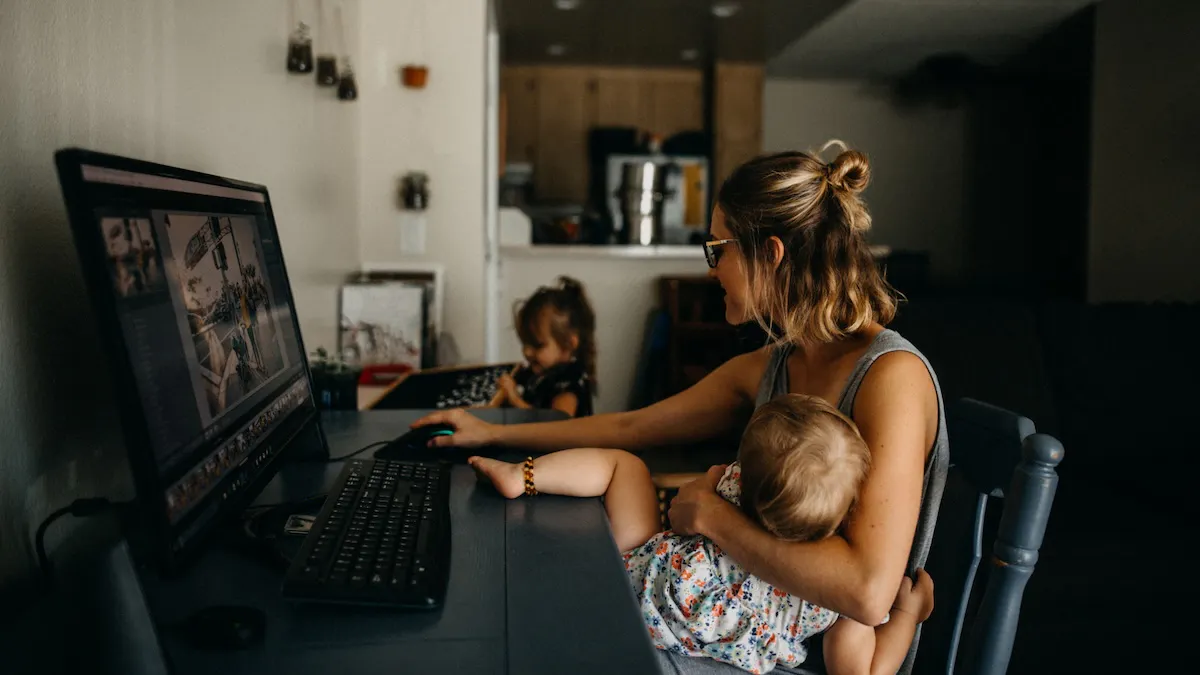
For generations, the conversation about motherhood has been framed as a binary choice: boss babe or homemaker? Corner office or weekly playgroup? But in more recent years, those two worlds have collided, with a quiet third option emerging as a viable alternative. Enter the full-time working mom who is also a full-time caregiver for her kids. It’s not a fringe phenomenon: One 2025 survey estimated that 2.3 million workers either keep their children home with them while working remotely or bring their children to the office.
Freedom Is Back
In Style
Premium domains for sale
Women are more likely than men to seek out these arrangements — and not just because of childcare. The flexibility that comes with remote work is increasingly seen as non-negotiable by mothers of young children. Data from the Brookings Institution found that remote work is most common among parents with children under five, with mothers of young children logging the highest rates of fully remote work across all demographic groups.
When I put out a call on social media asking for mothers who were working from home without external childcare to share their stories, the response was overwhelming. No two situations were exactly alike. Some working moms had occasional help — from family, part-time nannies, or a spouse working different shifts. Others swapped childcare with other working moms. There were also plenty doing it completely alone: single mothers or married women whose husbands worked long hours outside the home.
Everyone was cobbling together a slightly different version of this seemingly impossible arrangement. What most had in common was a deep sense of gratitude, a heaping side of guilt, and the constant urge to prove themselves.
The nap time hustle is real
Molly, an SEO manager and mother to an eight-month-old and a six-year-old, does the majority of her work around her kids’ schedules. She describes her days as wholly dependent on them.
“The nap time hustle is a real thing. Sometimes I feel like I can get more done in that two-hour nap than I can in a four-hour time span when my son is awake,” she told The Daily Wire in an interview.
Molly checks email during school pickups. She gets back on her computer after the kids are in bed, often until 10 p.m., and is the first to admit that work-life separation isn’t her strong suit.
“I’m pretty awful about separating work and personal life right now, but I know that life won’t always be like this,” she said.
Kate, a content marketing writer for a fintech company with a 10-month-old, left a job she loved because its strict in-office culture left her no flexibility. Her new role pays more and allows her to work from wherever she wants.
“When I’m on a video call, I’m usually muted while [my son] throws blocks around the room at my feet,” she admitted. “I haven’t sat at my desk in months; my laptop is often precariously balanced on a surface high enough to keep him away from the keyboard.”
Nap time, when it happens, is sacred. Evenings and weekends are spent catching up. She wakes at 2 a.m. sometimes — not just because of the baby, but because her brain won’t stop working.
These mothers are staking a claim to something that doesn’t have a clean label yet: making money and achieving professional success, but also being there when the kids get home from school. Breastfeeding between meetings. Reading picture books on their lunch breaks. Being present, even imperfectly, for all of it. They’re doing it by necessity, by choice, or — more often than not — some complicated combination of the two.
There is a stigma associated with working from home with kids, though. One popular Instagram influencer with nearly 200,000 followers — who regularly shares her real name, profession, and work-from-home-with-kids content online — declined to be interviewed for this piece.
“It makes no sense with me sharing online, but something for an article feels too official,” she wrote in response to an interview request.
She wasn’t alone in her hesitation. Even on the social media thread where I solicited respondents, there was pushback from strangers. “[Women] shouldn’t be doing this,” one commenter wrote. “Let’s not normalize this.”
The judgment comes from both sides: traditional working moms can be skeptical that someone is really pulling her weight while wrangling a toddler, and full-time stay-at-home moms sometimes assume the kids are running feral. Neither is exactly right.
Guilt that never clocks out
Unlike the influencer, dozens of full-time work-from-home moms were eager to share their strategies, triumphs, and challenges. One mom was candid with some of her tips for success.
“Full disclosure: I use a mouse jiggler to keep my Teams status green and computer from locking between the hours of 8:30 and 5,” she told The Daily Wire. But that admission doesn’t mean she’s a slacker.
In the same breath, this mom mentioned how important it is to her not to back off responsibilities or display anxiety about her workload. As part of a small team of parents with older children who largely trust her to hit her deadlines, she says the pressure to perform at pre-baby levels is constant. Still, she recognizes her most important role.
“You are replaceable in your workplace, but the time with your children while they are young is finite and precious,” she said.
If there was one word that surfaced again and again in these conversations, it was guilt. If the moms focus on work, they feel like they’re neglecting their kids. If they step away to push their kids on the swings, they feel like they’re shortchanging their employers — even when their in-office colleagues spent the same 20 minutes making a Starbucks run.
Jenna, who works in tech sales and has a three-year-old and a four-month-old, described it by saying, “It’s so hard trying to repeatedly explain to [my daughter] that I have to work and can’t focus on her as much as I want to. And then it’s simultaneously hard to really focus on work when she’s constantly asking me to play. I feel guilty either way.”
Her employer knows her kids are at home with her and is understanding. But the voice in her head is the loudest critic. “I know that I’m way harder on myself about it than any of them are on me,” she added.

Getty Images
Jessica, a director of marketing at a digital marketing agency with a two-and-a-half-year-old son, has the receipts to prove it can work.
“I have seen comments on social media from people who say that it’s not possible to work from home with kids without being a terrible employee — and I fully disagree,” she said. “I have a great working relationship with my boss, I never miss deadlines, and have received promotions and raises during my time working from home with my son.”
Not everyone is working from a home office. Laurel takes a different approach entirely: She brings her nearly two-year-old twins to the office where she works for a small vitamin and supplement company.
When she found out she was having twins, her company didn’t even have a maternity policy. Faced with the high cost of living in her state, she went to her boss — who has older children he used to bring to the office himself — and they agreed to try the arrangement on a trial basis.
That was almost two years ago. Now there’s a dedicated room in the office with two pack-and-plays, a changing table, and a sound machine. When the twins nap, the office runs normally. When they’re awake, they play in their mother’s office or attend meetings with her. She advocated for more companies thinking outside the box like this.
“I feel like everybody is just used to the status quo, and it’s just not something that we do. But I really wish that we would, because so many moms are going through this,” Laurel said of her arrangement.
She’s floated the idea of the company hiring a part-time in-office babysitter, or creating a dedicated childcare space as an employee benefit — a model she believes is more feasible than most corporate cultures are willing to consider.
What do these mothers want employers to understand? Molly’s answer cuts to the heart of a disconnect that runs through nearly every story.
“I love seeing the term ‘flexible hours’ on job listings, but I’m not sure that most companies actually use that term correctly,” she said. “If you can find a working parent that is willing to work mornings, evenings, or weekends to make sure their job gets done and gets done well, I think you’ve found a really great employee.”
Challenging the status quo
For some of these women, the arrangement wasn’t a lifestyle choice; it was a means of survival. Micaela became a virtual assistant after leaving an abusive marriage and being financially cut off, building a career from scratch while raising a two-year-old alone.
“I feel a lot of pressure throughout the day to figure out how I’m going to fit all my hours in,” Micaela said. “Whenever my son is asleep or otherwise occupied, I feel torn between the pressure to get my hours in, take care of my home, or take care of my own self-care.”
She’s also become an advocate for how employers think about mothers more broadly.
“I think most employers undervalue mothers,” she told The Daily Wire. “Most moms are some of the hardest-working employees, and when employers are flexible and understanding in regard to children, it opens up the hiring pool and reduces work-life balance-related stress.”
Sarah, a Stitch Fix stylist and Amazon content creator in Minnesota with three children ages five, three, and almost two, has two part-time jobs totaling 40 hours a week and homeschools all three of her kids.
“Some days, things go sideways and you’re going to feel like a failure. Some days, you’ll feel like you’ve totally got it all figured out,” she said. “The biggest benefit is that I get a front row seat to my kids growing up. Nobody knows them better than I do. There are only so many years of your kids being little — be there.”
The working from home with kids life has become a reality for millions of moms. Their children are learning independence, adaptability, and the value of hard work modeled by example. Their employers are getting employees who, by necessity, are more efficient, more motivated, and more determined to protect the life they’ve built.
Laurel put it best in the advice she’d give any mother thinking about trying this: “Try not to compare your old self to your current self because it’s easy to get in your head about productivity and all that. Just try to be grateful for the experience. In the end, you will look back and realize that it was such a blessing to have that opportunity.”
Not everyone will get that opportunity. But for the women who do, they’re not necessarily failing at both. They’re going down the long road to inventing something new.
More from this network:
Domains for Sale · GOTPeople.org · TheDSAPlatform · The Truth About Socialism
What's Your Reaction?
 Like
0
Like
0
 Dislike
0
Dislike
0
 Love
0
Love
0
 Funny
0
Funny
0
 Wow
0
Wow
0
 Sad
0
Sad
0
 Angry
0
Angry
0

I am just an average American. My teen years were in the late 70s and I participated in all that that decade offered. Started working young, too young. Then I joined the Army before I graduated High School. I spent 25 years in, mostly in Infantry units. Since then I've worked in information technology positions all at small family owned companies. At this rate I'll never be a tech millionaire. When I was young I rode horses as much as I could. I do believe I should have been a cowboy. I'm getting in the saddle again by taking riding lessons and see where it goes.
Premium domains for sale
























Comments (0)