

Trump Calls Iran’s Bluff. Now He’s Going Straight For The Jugular
Premium domains for sale
Freedom Is Back In Style
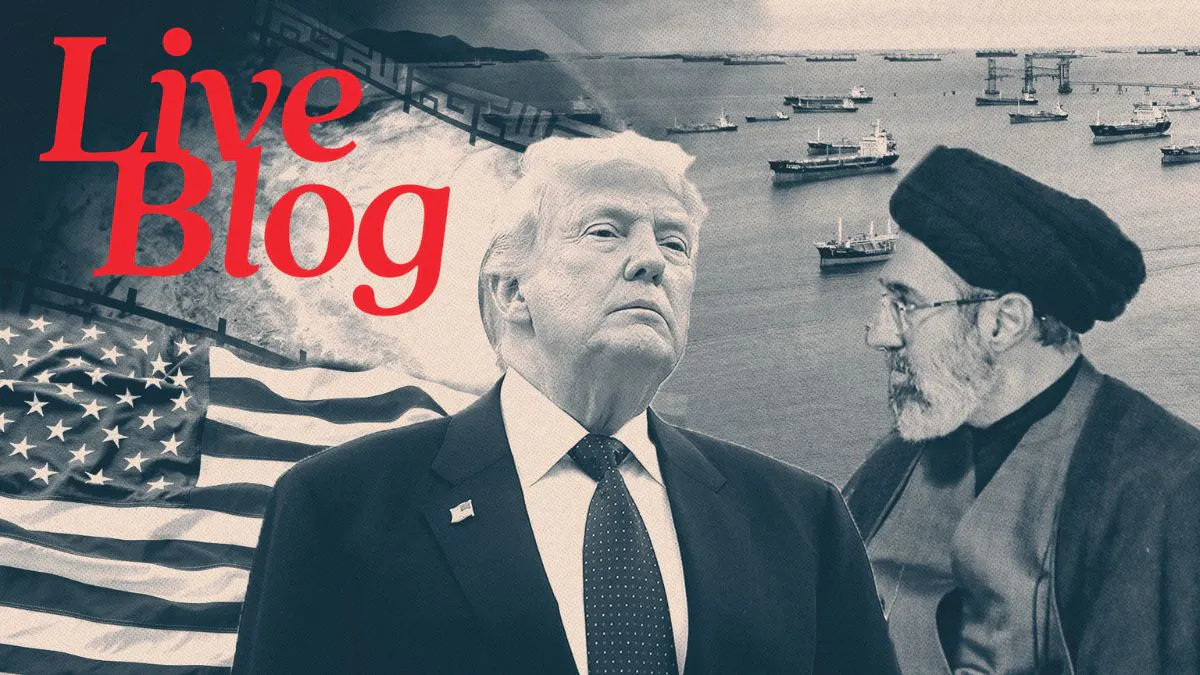
President Donald Trump announced on Sunday that the United States Navy would begin blockading the Strait of Hormuz, effectively sealing off Iran’s primary maritime artery, an action that will cripple the Iranian regime’s capacity to resist the United States.
Freedom Is Back
In Style
Premium domains for sale
“The meeting went well, most points were agreed to, but the only point that really mattered, NUCLEAR, was not,” President Trump stated. “Effective immediately, the United States Navy … will begin the process of BLOCKADING any and all ships trying to enter, or leave, the Strait of Hormuz.”
The president characterized Iran’s maritime behavior as “WORLD EXTORTION” and warned that any vessel paying an “illegal toll” to Iran would be denied safe passage. “Our Military will finish up the little that is left of Iran!” he added, noting that U.S. Central Command (CENTCOM) will begin full enforcement on Monday, April 13, at 10:00 a.m. ET.
While the military rhetoric is sharp, Miad Maleki, a senior fellow at the Foundation for Defense of Democracies (FDD) and former U.S. sanctions strategist, warns that the economic consequences for Tehran will be absolute. Maleki calculates that the blockade will inflict roughly $435 million in combined economic damage every single day—totaling a staggering $13 billion per month.
According to Maleki, over 90% of Iran’s $109.7 billion in annual trade transits the Persian Gulf. With oil and gas accounting for 80% of government export earnings and 23.7% of the national GDP, the closure of the Strait “zeroes this out overnight.”
The statistics provided by Maleki paint a grim picture for Iran’s energy infrastructure. Kharg Island, which handles 92% of the country’s crude exports, generates between $53 billion and $78 billion in annual revenue. Under the blockade, the 1.5 million barrels per day Iran was exporting—valued at $139 million daily at wartime prices—will cease entirely.
Furthermore, the petrochemical sector, which saw $19.7 billion in exports over a nine-month period in 2024/25, faces a daily loss of $54 million. Maleki notes that Iran’s non-oil exports, including minerals and metals, will lose another $79 million per day.
The blockade targets the heart of Iranian logistics. The Shahid Rajaee port handles 53% of all cargo operations, while Imam Khomeini handles 58% of basic goods imports. Maleki argues that Iran’s attempts to bypass the Strait are “negligible.” The Jask bypass operates at only 70,000 barrels per day—a fraction of its intended 1 million barrel capacity—and the five Caspian ports combined can only handle 11 million tons of cargo compared to the 220 million tons that move through the Gulf.
The internal impact is expected to be catastrophic. With food inflation hitting 105% in February 2026 and rice prices up sevenfold, the loss of $159 million in daily imports will accelerate a total currency collapse. The rial has already plummeted to 1.5 million per dollar, forcing the regime to issue a 10-million-rial banknote worth a mere $7.
Perhaps most critically, Maleki points to a “storage clock.” Iran has roughly 20 million barrels of spare onshore storage capacity. At current production levels, this will fill in just 13 days. Once full, Iran must “shut in” its wells. Maleki warns this could cause “water coning,” permanently destroying 300,000 to 500,000 barrels per day of production capacity. This would result in a permanent loss of $9 billion to $15 billion in annual revenue, even if the blockade eventually ends.
“The blockade,” Maleki concludes, “makes continued resistance economically impossible.”
1/10 The U.S. naval blockade of the Strait of Hormuz would cost Iran approximately $276M/day in lost exports and disrupt $159M/day in imports, a combined economic damage of ~$435M/day, or $13B/month.
Over 90% of Iran's $109.7B in annual trade transits the Persian Gulf. Oil/gas… https://t.co/fOwhRltQhv
— Miad Maleki (@miadmaleki) April 12, 2026
More from this network:
Domains for Sale · GOTPeople.org · TheDSAPlatform · The Truth About Socialism
What's Your Reaction?
 Like
0
Like
0
 Dislike
0
Dislike
0
 Love
0
Love
0
 Funny
0
Funny
0
 Wow
0
Wow
0
 Sad
0
Sad
0
 Angry
0
Angry
0

I am just an average American. My teen years were in the late 70s and I participated in all that that decade offered. Started working young, too young. Then I joined the Army before I graduated High School. I spent 25 years in, mostly in Infantry units. Since then I've worked in information technology positions all at small family owned companies. At this rate I'll never be a tech millionaire. When I was young I rode horses as much as I could. I do believe I should have been a cowboy. I'm getting in the saddle again by taking riding lessons and see where it goes.
Premium domains for sale















Comments (0)