

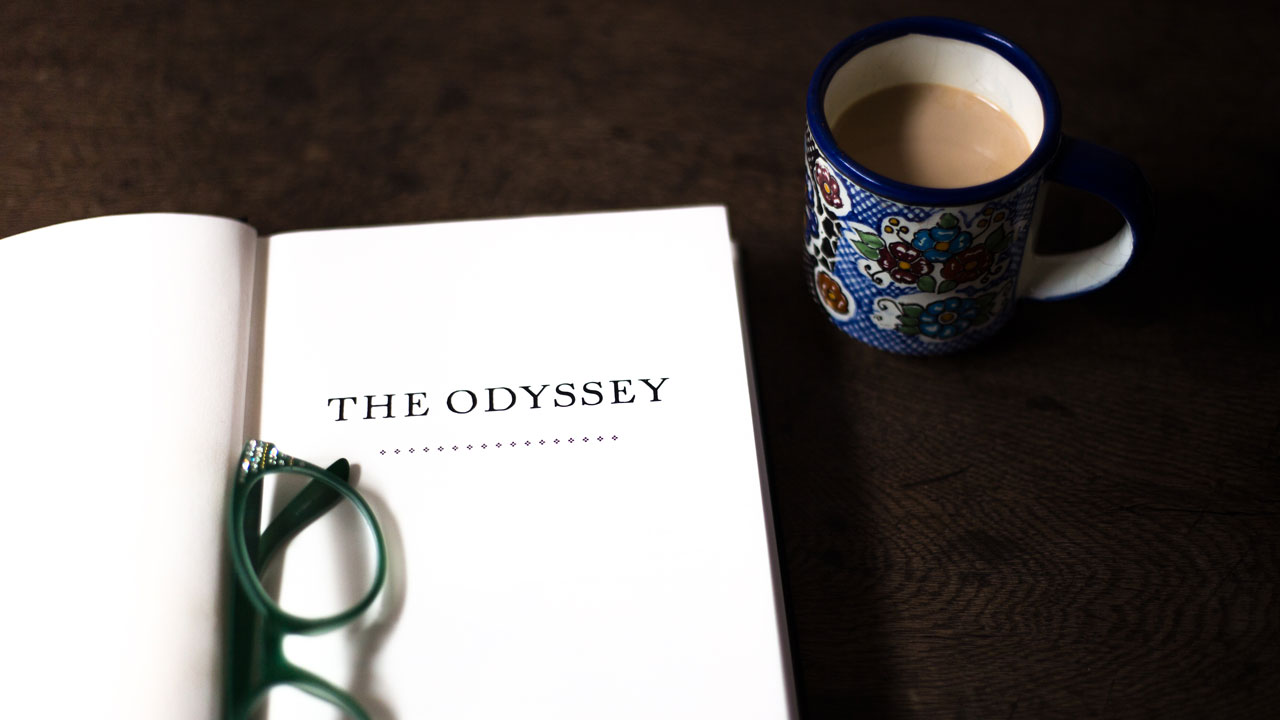
Victor Davis Hanson: ‘The Odyssey’ Is Disappearing From American Education
Premium domains for sale
Freedom Is Back In Style
Editor’s note: This is a lightly edited transcript of today’s edition of “Victor Davis Hanson: In His Own Words” from Daily Signal senior contributor Victor Davis Hanson. Subscribe to Victor Davis Hanson’s own YouTube channel to watch past episodes.
Freedom Is Back
In Style
Premium domains for sale
Jack Fowler: If we were transported back 50 years, Victor, I wonder how many—not even college students—high school students may have read some of “The Odyssey,” may have read “The Iliad,” known who Aeneas was, knew who Agamemnon was, and would know these great characters from classical literature.
But my gut tells me if you’re entering Harvard, this is news.
Well, actually, what you were talking about with Sami on the most recent podcast, the actress who’s the star of the new movie—and she’s a Yale graduate.
Victor Davis Hanson: Yes. Lupita Nyong’o. She said something I couldn’t quite believe.
She got her master’s in theater arts at Yale, and she said she had never read “The Odyssey” before, and she’s 42. I thought, “How is that possible?” Her undergraduate institution, I’ll remember in a second, was excellent. She went to Yale, but she’s never …
I taught 21 years at Cal State Fresno, Humanities 10, Introduction to Western Humanities. We started with Homer, so I would either have The Iliad, but mostly I taught “The Odyssey” because it was much more of an adventure story and easier to understand for most students.
I think I had 50 students, and I repeated it in the spring semester. That was 100 a year, and for 10 years that would be 1,000.
So, I had 2,000 students at Cal State University taking that class, and most of them were from families below the median income. Most of them were either part of the poor Oklahoma diaspora, Mexican American, first- or second-generation, or from Southeast Asia during the influx after the Vietnam War.
My point is, they weren’t from old families, and they weren’t at a privileged institution. Yet they had experience with “The Odyssey,” and they were very good students.
Then I taught that in Greek maybe five times. So, when I hear this actress say that she has never read it, well, that’s OK.
But then she starts opining on what’s wrong with it, and she says that it doesn’t have enough feminist characters. I thought to myself, let’s count them up.
Let’s just look at the male characters. We can get rid of 20 suitors and people like Antinous or Eurymachus. They’re awful, and they’re portrayed that way.
How about Odysseus’ own crew? They’re wild. They’re mercurial. They’re told, “Don’t eat the cattle of the sun.” They do it. Circe turns them into pigs.
How about the male gods? Zeus, it seems to me, and Poseidon are vindictive and mean. It’s Athena who is the patron of Odysseus. She is the calm, wise, stern woman.
Maybe she represents someone Homer knew within his own experience. She’s not very sexual, she’s called the Parthenos. That’s a very rare Greek noun ending in -os that’s feminine. She’s a virgin. But she’s all over “The Odyssey.”
And then, of course, the pièce de résistance is Penelope. The loyal, dutiful—but not sulking—little housewife at home. Where’s my husband?
No. He’s gone for 20 years, and her attitude is, “I’m going to use all my brilliance to outsmart these stupid men. I’m going to weave a rug every day. As soon as I get done with this weaving project, I have to get married to one of them, and they’ll steal the whole sustenance of the palace at Ithaca.
“So I’ll just undo my weaving every night.”
When it’s time to finally reunite …
She’s the one that comes up with all of these tricks about shooting the arrow through the axe heads.
When they finally get reconciled, she’s the one that wants to test him.
“Why don’t you move the bed, dear?”
“I can’t. Don’t you know that? It’s an olive tree. It’s rooted.”
“Oh yes, I was just testing you.”
Then there’s the wily Circe. What a witch. Maybe Homer saw a woman like that. She defined her own sexuality. She thought, “If pigs are pigs, men are chauvinist pigs, I’ll turn them into pigs with my supernatural powers.” And she does that.
Then maybe when he sees Calypso, he finds a woman. Maybe Homer knew a woman who said, “I’m going to stake out my own 40 acres. I don’t need anybody. I’m completely independent.”
That’s Calypso. She has her own island, and she basically makes Odysseus her sex slave for seven years.
He cries, “Oh, I want to go home. Please let me go home.”
“No, no, no. Get back in here. I’ve got to service you.”
That’s basically the crude version. Then she’s told by Hermes she has to let him go.
The big controversy, Jack, is she plays two roles, and the popular press have it wrong. She plays Helen and Clytemnestra.
They say, “Why does she play two roles?”
They were a funny group because King Agamemnon at Mycenae married Clytemnestra, and his brother Menelaus of Sparta married Helen, the sister of Clytemnestra. So, she is playing two sisters.
Where we get to the controversy is that she’s described in “The Odyssey” as fair-skinned and the most beautiful woman in the world.
People have said the actress playing the part is not fair-skinned. It’s a deliberate effort not to make the actress look like what Homer intended.
And then the controversy hit. The controversy is so multifaceted.
Do you think people who do not look like the character intended by the producer, director, screenwriter, or novelist should play that role? Or is that an appropriation of their intent?
Shakespeare has Othello. Was it wrong for Sir Laurence Olivier to play Othello? Should it always be James Earl Jones because he is black and more of a Moor?
Is it wrong for Audrey Hepburn? Remember “The Unforgiven,” Jack? The John Huston Western. She played, very unconvincingly, a Native American who had been kidnapped.
Then there was, I think, Burt Lancaster and Charles Bronson, who made a sub-career playing renegade Indian heroes.
Fowler: Indians.
Hanson: Is that wrong? People of color have said it’s wrong because they took roles that could have gone to people of color.
Then you want to ask whether being Indian is essential to the role.
Is Cochise or Geronimo, or whoever, an Indian nationalist? If so, it seems to me that if you have Indian actors, that might be more convincing.
I’m looking now at some of the great movies we’ve seen that had actual Indian actors. “Little Big Man” had actual Indian actors.
So did Clint Eastwood‘s…
You know that movie I’m trying to remember.
Fowler: Not “Hang ‘Em High” …
Hanson: No, I’ll remember in a minute.
Fowler: “The Outlaw Josey Wales.”
Hanson: “The Outlaw Josey Wales.”
He had that famous actor who was Native American.
Fowler: Right.
Hanson: There are a lot of them.
I could go on. It’s just a question of whether the race of the actor is essential to the play. If without that portrayal it affects the content, then you probably should have that type of person in that role if you can. But if it’s incidental, it doesn’t really matter.
We publish a variety of perspectives. Nothing written here is to be construed as representing the views of the Daily Signal.
More from this network:
Domains for Sale · GOTPeople.org · TheDSAPlatform · The Truth About Socialism
What's Your Reaction?
 Like
0
Like
0
 Dislike
0
Dislike
0
 Love
0
Love
0
 Funny
0
Funny
0
 Wow
0
Wow
0
 Sad
0
Sad
0
 Angry
0
Angry
0

I am just an average American. My teen years were in the late 70s and I participated in all that that decade offered. Started working young, too young. Then I joined the Army before I graduated High School. I spent 25 years in, mostly in Infantry units. Since then I've worked in information technology positions all at small family owned companies. At this rate I'll never be a tech millionaire. When I was young I rode horses as much as I could. I do believe I should have been a cowboy. I'm getting in the saddle again by taking riding lessons and see where it goes.
Premium domains for sale

















Comments (0)