

Victor Davis Hanson’s Message to America for Its 250th Birthday
Premium domains for sale
Freedom Is Back In Style
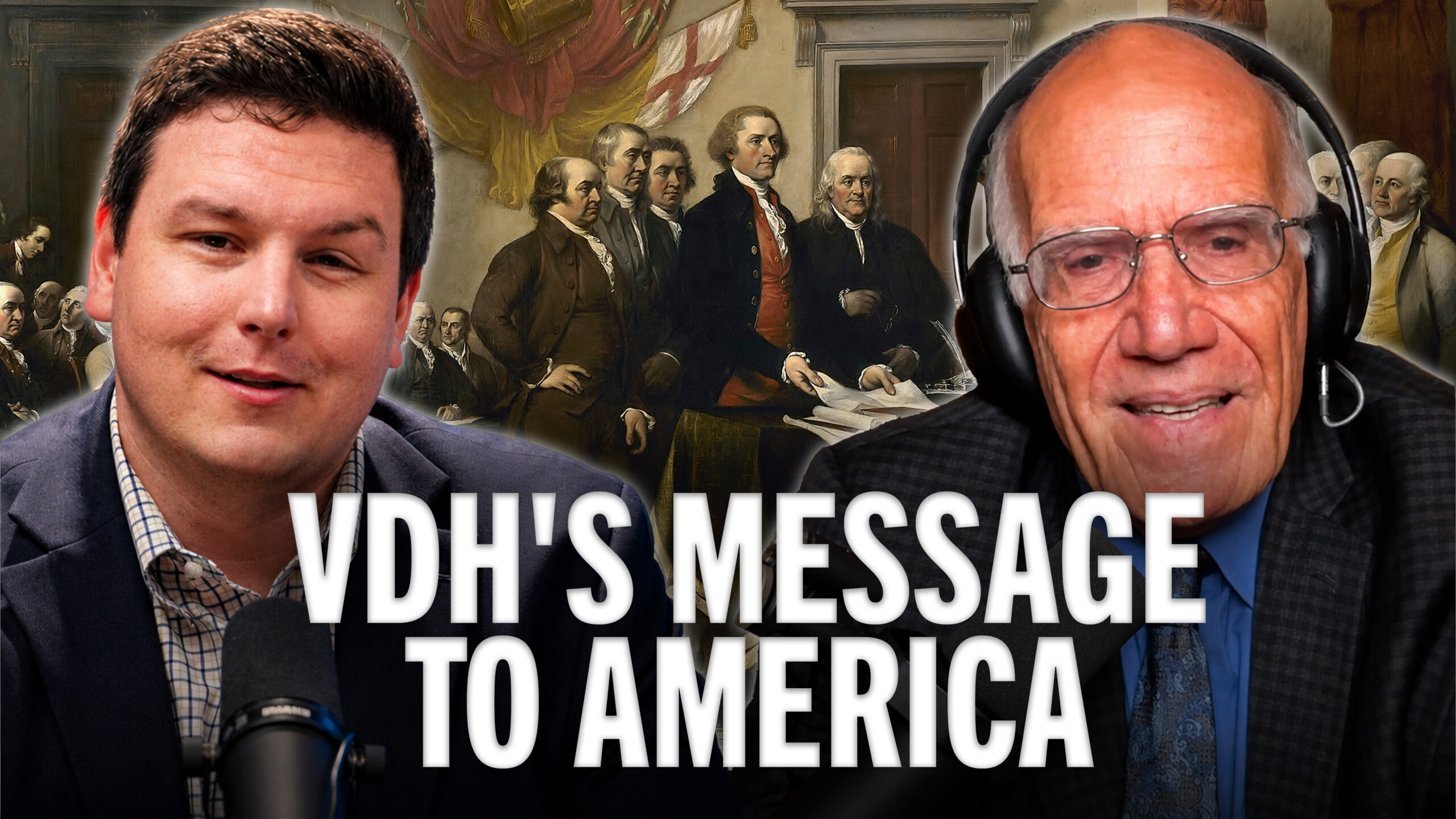
The following is an excerpt of Daily Signal Politics Editor Bradley Devlin’s interview with Victor Davis Hanson for the “Signal Sitdown,” which premieres on the Daily Signal’s YouTube page at 6:30 am EDT on July 2.
Freedom Is Back
In Style
Premium domains for sale
Portions of this interview are featured in Daily Signal’s new documentary “Sacred Honor: The Declaration That Defines a Nation,” premiering at 8:30 pm EDT on Daily Signal’s YouTube page.
This transcript has been edited for clarity.
Bradley Devlin: On July 4th, they approved the Declaration of Independence, and that document is signed over the course of the next few months. But these men, by signing that document, 56 men mutually pledged to each other their lives, their fortunes, and their sacred honor in support of the Declaration and under the providence, the providential hand of God.
When you think about that moment, how heavy that must have been. Tell us a little bit about the intensity that was probably in that room as they pick up that quill and sign the Declaration.
Victor Davis Hanson: Well, they were all there because their peers had selected them or the people had selected them. And so they were men of education, they were men of stature, they were men of, many of them, of land and wealth.
And so when they signed that, and they didn’t really have an army, and they were taking on the most powerful military in the world that was reaching its apex, then what they were really saying is, “If this doesn’t work, all the generations following me are gonna be destitute because I’m gonna lose all the land, all their inheritance.
“I’m gonna probably lose my life. I’m gonna be branded a traitor a rebel.”
And they knew that whether they succeeded would determine how they were seen. If they failed, they would be called traitors and rebels. If they were successful, they might be revolutionaries or idealists or founders. But at that point they signed, the odds, if we had to make a bet, I think most people would’ve bet on the Crown, given the comparative resources, even though it was a distant theater.
So they were undertaking a very improbable mission that might end in their disgrace, their bankruptcy, and their death. They would be hanged to set an example. And it was a very dangerous thing to do.
Bradley Devlin: When you think about the Roman Republic 250 years into its history, it’s expanding, it’s very strong, it’s still on the rise.
And here we sit today, 250 years into the American Republic, hoping to keep it alive for the next 250 years. That wasn’t the case for Rome. 500 years into its history, the Roman Republic is gone. It has turned into an empire.
If you would, compare and contrast the Roman Republic 250 years in versus the American Republic 250 years in, and perhaps how we preserve our republic for longer than Rome did.
Victor Davis Hanson: Well, what destroyed the Republic starting in the mid-second century BC with, say, the destruction of Corinth and the accumulation of what is now most of Greece or all of North Africa with the destruction of Carthage in 146 or Caesar’s complete annexation of Gaul, a million slaves that they brought in, was that as they had.
Once they developed this system of stable government and they mastered the legions, and they were yeoman agriculturalists from Italy, and they were wonderful fighters, they found that they could expand exponentially both north, south, east, or west.
But the problem was that this republican government was not set up for that. It wasn’t designed for that. It shouldn’t be designed for that. So once, when you sent someone out with an army supposedly to defend the borders of Rome, but really preemptively to expand them, once they went into places like modern-day France, or they went into Ionia, the rich parts of modern-day Turkey, or they went into the Nile area, they found that there was greater, far greater wealth outside of that than Italy.
And these people then were governing as prefects or generals. They were governing areas with populations and money and territory that were far greater than what the Republic was, run by the Senate and the two consuls.
So this led to the Sulla and Marius rivalries. But their armies were… A man could come from the provinces with a richer army, a bigger army, and more importantly, a more battlefield army than the Senate could raise.
And so when Caesar crossed the Rubicon in the last gasp of the Republic, Pompey just fled because here was a guy who’d been battle-hardened for 10 years in Gaul. He had enormous amounts of money he expropriated, and the Senate was completely enfeebled.
So the Founders knew that, but in the case of the United States, they were very worried that you might have. That’s one of the reasons Aaron Burr was so dangerous, or they thought he was.
He was so notorious because somebody could go out to the West and carve out a territory, and that’s why they were later so paranoid about the Mormons in Utah, that there would be people that would go out and get territories and create fiefdoms that would be not just immune from the federal government but might be more powerful than the federal government, and a good story is when [Gen. William Tecumseh] Sherman went through the march to the sea from Atlanta to Savannah, then he went up from the Carolinas.
He had an army of sixty-five thousand people. And they were, these were not the army of the Potomac that were Irish and German immigrants that were being killed, wounded, and then right off the boat being replenished. These were hardcore farmers that had marched and lived off the country, and they were dressed in rags by the time they got to the military parade.
And the first thing that the German military attaché is, “This man is more powerful than anybody in Washington, and that army could beat any army in Europe.” And they didn’t know what Sherman was gonna do with it. They thought, “Wow, he’s taken over the whole South. He’s marching up here. He’s very angry at the Secretary of War. What will he do?”
And then he kind of played with that for about a day or two before he disbanded it. So the Republican governments are not equipped very well for overseas conquest. And that’s why in our history, every time that we tried to in the Spanish-American War, we tried to deal with the Philippines, there was a great outrage.
You don’t wanna annex Cuba. You don’t wanna annex the Philippines. You can be a caretaker. You can nurse them along, but it’s very against our creed because I think Pat Buchanan said, “A republic, not an empire.” And that was the idea that an imperial rule would distort republican government, and Rome was the best example.
Nobody really mentioned that the principate and the empire lasted for five hundred years. And in Rome from, say, 31 BC to, I don’t know, 476, there were local councils that were democratic, not democratic, but constitutional. And they functioned as they always had. It was just the imperial government was autocratic, and the Senate was sort of a joke.
But they were afraid of that. And especially when you had this large territory they kept absorbing, they didn’t have enough people to defend it. They knew it was very wealthy, and they really, they were worried about slavery, what would it would take off on the frontier. So that was a concern.
Bradley Devlin: All these concerns and yet they’re able to prudently navigate these political circumstances, give rise to this great country you and I both call home.
If we’re not going to go the way of Rome, even though our system is set up to hopefully avoid that, for us to avoid going the way of Rome, how do we recover the statesmanship and the politics of the higher nature of our founding and bring that into today and pass that down to posterity?
Victor Davis Hanson: Well, I think it was about 50 years ago that we stopped in our K through 12 schooling system teaching what we used to call ethics and civics. In other words, how to be moderate. I went to a rural school two miles away and we had those courses and they entailed everything about being a citizen.
“Mr. Victor, would you come to the front of the room? We’re going to shake hands with principal. Let’s see how you shake hands. No, you look him right in the eye. Don’t be too firm. Don’t be too weak.”
And then every morning, “Gracie Martinez, would you please choose your national anthem today? Is it going to be ‘God Bless America,’ ‘America the Beautiful, My Country ‘Tis of Thee,’ the American ‘Star-Spangled Banner’? Which is it, Gracie?”
And she would pick and we’d all sing and she would go around the room. And in the classrooms, there were all the president silhouettes and then without the names. And we had tests as early as third grade to look at the silhouette and then identify the president. And they were not in the order of their presidencies.
They were all mixed up. That was just commonplace at a very poor rural school that was 90% Hispanic. So if you don’t have a civic education and you don’t have courses in classical ethics … It was always, “You don’t have any money, Victor. You’re going on the campus, you’re going on our little playground and you find a wallet and it has $10 and there’s no driver’s license. What do you do?”
“Well, you don’t have money. Why don’t you just take it? Nobody knows who it is.”
“No, you take it to Mr. Cagle, the principal, and you write out a report and this is why.”
We don’t do that at all. It’s situational now. And then the other thing is they were able to. They had an idea once the Anglo-Saxon British experiment was working and there started to become early immigrants from Germany especially, and Scandinavia, and then later from Eastern Europe, and then from Russia, and then from Southern Europe.
They were able to incorporate them as citizens, and they had a guiding principle that they came to the United States. We didn’t invite them. They came here. And they, it’s the brutal bargain we call it now. They said to them, “You can have your flag on ceremonial days. You can have your food, your music, your literature, your everything that will enhance the American experience.
“But do not tamper with the core. Whether you like it or not, we don’t have an official religion, but we are a Judeo-Christian country that imbues our values. Here’s the Constitution, here’s our judicial system. Don’t try to change that.”
That’s a very different concept from the current one that “We’re lucky to have you. Thank you for coming, and we don’t want to judge you.”
And we have 53 million people that weren’t born in the United States, 16%, highest we’ve ever had, 27% here in California. And we don’t dare question your culture versus ours. And maybe as I think the late Justice [Ruth Bader] Ginsburg said, “Maybe we have a lot to learn from the Constitution of South Africa,” she said.
Or the President of the United States, Barack Obama said, “Yeah, we’re exceptional in the sense only that Britain thinks they’re exceptional and the Greeks think they’re exceptional.”
So if you don’t have that inclusive citizenship that we’re all on the same page no matter what are we look like, what, no matter what race, but we’re all part of this melting pot and we’re a nation of ideas, and that’s the ultimate expression of the Declaration.
If you say all men are created equal and you don’t specify a national religion, then everybody can come here regardless of their race, regardless of their origin, as long as they understand that there is a cultural ethos that came from the founders and there is a foundational document, the Constitution.
And then federalism, constitutions of the various states.
But we don’t have that now. We have people coming all over and almost their first reaction is “Well, what is in it, what is in it for me? What do I get? And I’m a victim and you. I have claims against the majority.”
And I think that would be so foreign to what the country was.
Even John F. Kennedy, “Ask not what you can, what your country can do for you, ask what you can do for your country.” That was kind of the mantra of the 1960s. So that’s a very big worry today that… And that I think it, that people like Samuel Huntington or Arthur Schlesinger Jr. were not necessarily conservatives, but they, at the end of their lives, they wrote books like “Who Are We?”
And they, they saw that this diversity was very dangerous to the country. And when you add the migrations to it, four to five million people leaving blue states to red states because of federalism, basically they’re saying that the federal, the blue state model is a failure and the red state model is preferable regardless of ideology.
Then you’re adding a geographical force multiplier to ideology, and we hadn’t seen that in this country since 1850s and ’40s, where if you were in the South, you were for slavery. If you were in North, you weren’t. There was a kind of a border between.
But pretty much if you go to Tennessee, Texas Florida, Alabama Idaho, Montana, it’s a different country than California or New York or… it really is.
Not just in the way people think and act, but in the infrastructure and things working. The elections in California don’t work, and the budgets of California and New York don’t work, and the big cities of Chicago and L.A. are not working. And that’s something that’s gonna be more and more an issue as the country starts to self-select and divide.
And I can envision a period, if it’s not dealt with, that in 30 or 40 or 50 years, you would create two distinct cultures. And there is a geographical component. Most of them are to the south, not all. There’s some up in the north but it’s going to be a very different country. It already is right now.
I’m very worried about it. I drive three and a half hours to Palo Alto, and I can tell you the San Joaquin Valley, when I did that as a student at Stanford, there wasn’t much difference, and now they’re completely different.
I go to Stanford and I’m very careful what I say, very careful when I’m in a restaurant or something.
And it’s just a different experience. And here, there’s a tolerance for any … there are all sorts of people who are politically different. And it’s just completely different.
And I don’t know how to express it, but when I get tense when I drive to the Bay Area now and park my car, and then I go on the campus, and even not even on the campus, downtown Palo Alto, Menlo Park, Atherton.
They have a very different idea of what America should be than people in the foothills of California or in red state America. And there’s not really anybody who’s trying to reconcile those differences.
I don’t know if they are reconcilable. One is a utopian view that human nature can be changed if you have enough power and leverage, and the other is tragic view that it’s not a therapeutic view, that we’re born imperfect and sinful, and we have to be very careful what we do, and we need custom, tradition, honor, religion, community, family to suppress our natural excesses.
The Left doesn’t believe that. And so that’s something that I don’t know if the Founders. I think they, they thought federalism would cure that and the frontier and federalism would serve as sort of a pressure valve. Frederick Jackson Turner maybe with the frontier, and then more importantly, federalism would create different…
And then they found out that federalism created the Civil War. And federalism cured the Civil War as well, but at the cost of seven hundred thousand lives. But when you see what people are saying and doing, it just it’s. We’re gonna have to have a… At some point, we’re gonna have to have, not a revolution, but a national come to Jesus moment.
I don’t mean that in a religious sense, but just say these, this is not working. I think everybody agrees the open border was not working, and massive immigration without audit or health backgrounds or anything was not working. I think both parties agree that $31 trillion in debt is not working, and there’s precedence for that in the Roman Republic.
You wouldn’t believe how many people in the Roman Republic, from what we can tell, thought that you could bring in Huns, Vandals, Visigoths, Ostrogoths across the Danube and Rhine, and they would be good Roman citizens without having to assimilate or interact.
And they turned out in very small numbers compared to the Roman population, but that was the end of the Western Empire.
And the Byzantines didn’t do that and lasted for a thousand years.
Bradley Devlin: Well, to avoid the fate of one Roman Republic we hope that our American Republic, structured, built on the foundation that was Rome and Greece and Jerusalem continues to survive for another 250 years and beyond.
Victor Davis Hanson: I hope so. I’m confident it will.
Churchill always was right. He said we always do the necessary thing last.
The necessary thing last.
More from this network:
Domains for Sale · GOTPeople.org · TheDSAPlatform · The Truth About Socialism
What's Your Reaction?
 Like
0
Like
0
 Dislike
0
Dislike
0
 Love
0
Love
0
 Funny
0
Funny
0
 Wow
0
Wow
0
 Sad
0
Sad
0
 Angry
0
Angry
0

I am just an average American. My teen years were in the late 70s and I participated in all that that decade offered. Started working young, too young. Then I joined the Army before I graduated High School. I spent 25 years in, mostly in Infantry units. Since then I've worked in information technology positions all at small family owned companies. At this rate I'll never be a tech millionaire. When I was young I rode horses as much as I could. I do believe I should have been a cowboy. I'm getting in the saddle again by taking riding lessons and see where it goes.
Premium domains for sale












Comments (0)