

Why Eisenhower Believed ‘Under God’ Was Vital to America’s Identity and Victory in the Cold War
Premium domains for sale
Freedom Is Back In Style
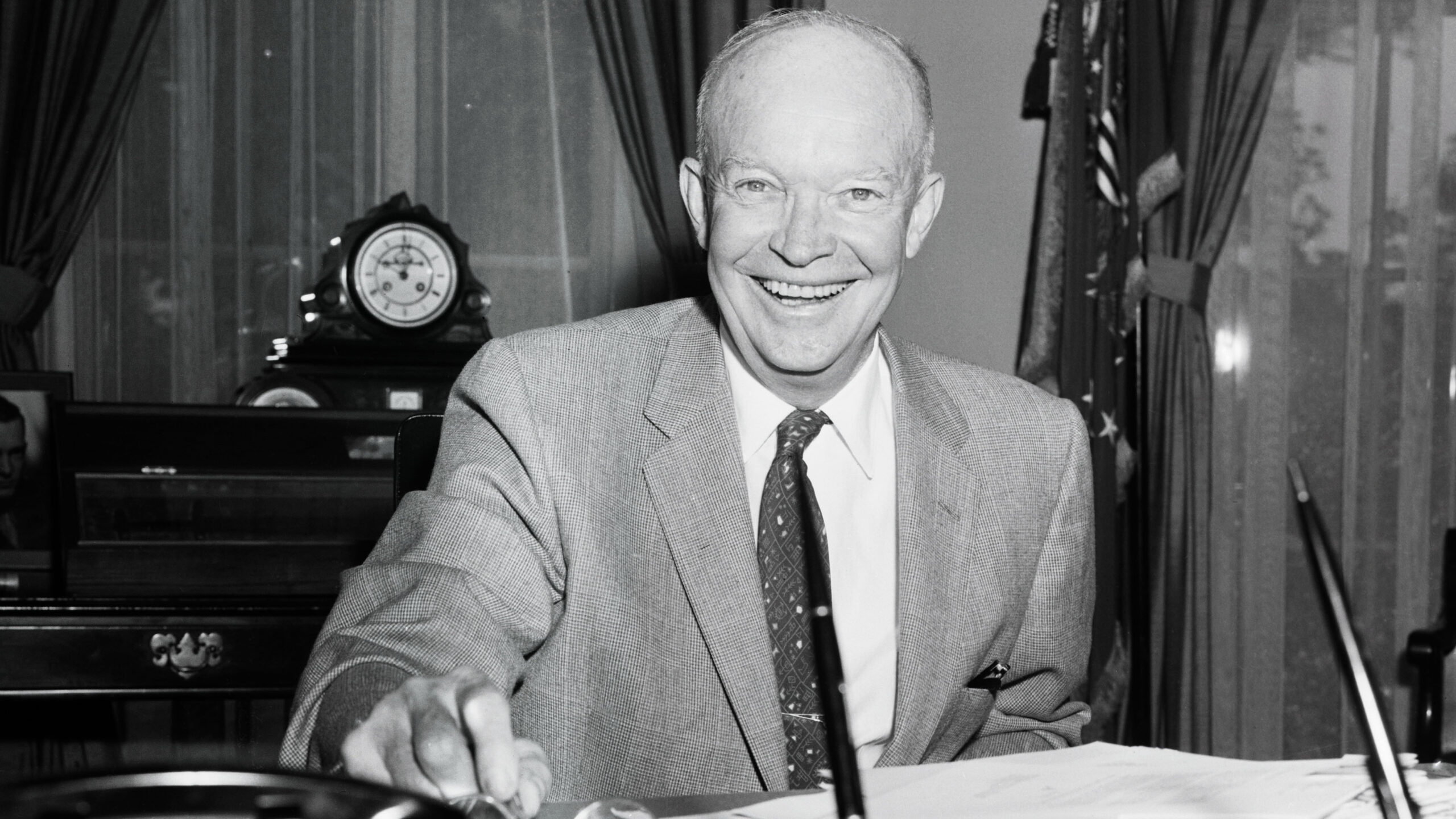
It was both a spiritual and strategic move when President Dwight D. Eisenhower signed a bill adding the words “under God” to the Pledge of Allegiance.
Freedom Is Back
In Style
Premium domains for sale
“From this day forward, the millions of our schoolchildren will daily proclaim in every city and town, every village and rural schoolhouse, the dedication of our nation and our people to the Almighty,” the president said upon signing the bill on Flag Day, June 14, 1954.
“To anyone who truly loves America, nothing could be more inspiring than to contemplate this rededication of our youth, on each school morning, to our country’s true meaning,” he continued.
“The Soul of an American President: The Untold Story of Dwight D. Eisenhower’s Faith,” written by Alliance Defending Freedom founder and former President Alan Sears and two co-authors, Craig Osten and Ryan Cole, details how faith was important to the 34th president well before he entered the White House.
“In World War II, he saw the concentration camps and it shook him to his core,” Osten told the Daily Signal. “He was convinced this is where a godless society ends up. He also looked at what was happening in the Soviet Union and the destruction of their churches.”
During the bill-signing remarks, Eisenhower made a subtle reference to the Cold War.
“In this way we are reaffirming the transcendence of religious faith in America’s heritage and future. In this way we shall constantly strengthen those spiritual weapons, which forever will be our country’s most powerful resource, in peace or in war,” Eisenhower said.
Critics of the bill have dismissed it as a geostrategic move to claim the moral high ground against the Soviets.
Osten stressed it was much more than that for Eisenhower.
“He looked at what was different about America. He believed the Soviet Union’s weak link was that it was an atheistic society,” Osten said. “It’s not that he was using religion as a weapon, but he did want to remind America of its spiritual roots.”
Osten added the president “wanted to make sure America didn’t drift the way Russia and Germany did.”
After the bill-signing ceremony, the former Supreme Allied commander met with an American Legion gathering at the Capitol, where he and the others recited the pledge with the newly added words “under God.”
As for the pledge itself, it had quite a journey before Eisenhower’s monumental act.
The first version of the pledge, which skipped from “ … one nation indivisible … ,” was interestingly enough written by Baptist minister Francis Bellamy in 1892 to mark the 400th anniversary of the discovery of North America by Christopher Columbus. It caught on that year, and schools and civic organizations began reciting it in the following decades.
It was during World War II, on June 22, 1942, that President Franklin D. Roosevelt officially recognized the pledge in signing the U.S. Flag Code.
It was well after the war, in 1951, that the Catholic group Knights of Columbus resolved to call on Congress to add the words “under God” to the Pledge of Allegiance. Rep. Louis Rabaut, D-Mich., introduced legislation adding the words to the pledge; the measure then passed both the House and Senate.
Though Catholics initiated the effort, Protestants weren’t far behind.
The measure gained significant momentum after Eisenhower listened to a sermon in February 1954 by the Rev. George Docherty at New York Avenue Presbyterian Church in Washington, D.C., a church frequented by former President Abraham Lincoln.
“To omit the words ‘under God’ in the Pledge of Allegiance is to omit the definitive factor in the American way of life,” Docherty preached.
The pastor said “under God” would include all faiths, such as Jews and Muslims. However, he added, “An atheistic American is a contradiction in terms. If you deny the Christian ethic, you fall short of the American ideal of life.”
That sermon convinced Eisenhower, according to The Washington Post.
Almost two months after the Flag Day bill signing, Eisenhower wrote a letter of gratitude to the Knights of Columbus Supreme Knight Luke E. Hart.
“And this year we are particularly thankful to you for your part in the movement to have the words ‘under God’ added to our Pledge of Allegiance,” Eisenhower wrote in the Aug. 6, 1954, letter. “These words will remind Americans that despite our great physical strength we must remain humble. They will help us to keep constantly in our minds and hearts the spiritual and moral principles which alone give dignity to man, and upon which our way of life is founded.”
More from this network:
Domains for Sale · GOTPeople.org · TheDSAPlatform · The Truth About Socialism
What's Your Reaction?
 Like
0
Like
0
 Dislike
0
Dislike
0
 Love
0
Love
0
 Funny
0
Funny
0
 Wow
0
Wow
0
 Sad
0
Sad
0
 Angry
0
Angry
0

I am just an average American. My teen years were in the late 70s and I participated in all that that decade offered. Started working young, too young. Then I joined the Army before I graduated High School. I spent 25 years in, mostly in Infantry units. Since then I've worked in information technology positions all at small family owned companies. At this rate I'll never be a tech millionaire. When I was young I rode horses as much as I could. I do believe I should have been a cowboy. I'm getting in the saddle again by taking riding lessons and see where it goes.
Premium domains for sale








Comments (0)