

AI Is Taking Over The Arts. But Humans Still Have One Secret Weapon.
Premium domains for sale
Freedom Is Back In Style
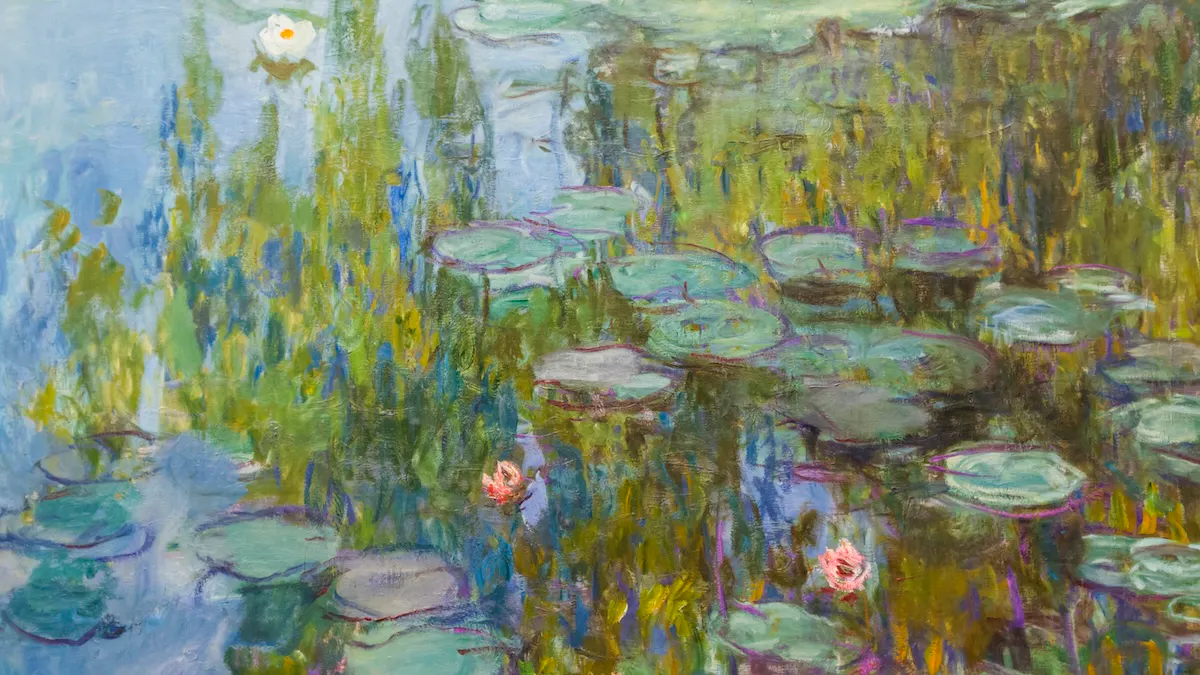
An anonymous user posted an impressionist painting on X a few months back and asked users to “describe, in as much detail as possible, what makes this inferior to a real Monet painting.” Viewers sounded off on the supposedly AI-generated image, criticizing the framing, choice of color, and the “slightly off” reflection of the trees. There was just one problem: The image was a real painting of Monet’s water lilies.
Freedom Is Back
In Style
Premium domains for sale
Most people are probably less successful at recognizing AI art than they think they are. When it comes to actual computer-generated imagery, people can identify AI only about half of the time. Research suggests, however, that people still intuitively prefer human art to AI art.
In a study conducted by Bowling Green State University, researchers found that when people looked at AI art and human-made art, they still preferred the man-made pieces even though they weren’t sure if the artwork was AI or not. People had “more positive emotions when looking at the human paintings,” according to the study. Something in us still prefers human work, and this subconscious preference runs deeper than what some might call “prejudice.”
Yet as AI revolutionizes every industry, including the arts, creatives and consumers alike fear that AI will infect the artist’s world and replace skill, experience, and time with efficiency, sufficiency, and replication. I took this concern to the professionals for some guidance, and their perspectives were more hopeful than I expected.
Man-made music to our ears
Dave Clifford, a musician, publicist, and band manager for roughly 20 years, says he doesn’t generally use AI in his work when it comes to music or artwork for bands. Sometimes he’ll employ Photoshop generative functions along with simple editing.
“Pretty much all the bands that I work with really kind of cherish their own creativity rather than use something like generative AI to do the creative process for them,” Clifford said.
While Clifford believes people will become more comfortable with AI as time progresses and it improves, he is not generally in favor of AI because it is “so sloppy and bad” and sometimes “disastrous.” Many bands would be affronted by the suggestion of generative AI in their work.
“There have been a couple of bands that I work with who have said outright, whenever there would have been some offers from people to create a tour poster or something like that … ‘Okay, well, as long as it doesn’t involve any AI in making it, then we’re fine with it,’” Clifford recalled.
Clifford doesn’t think AI could replace human creativity in music, saying AI is not creative itself but is something that is “doing a very poor job of replicating human creativity.”
“I don’t think that you can replace human creativity with those kinds of systems because we call it AI — it means artificial intelligence,” he said. “What it is, is just an amalgam of things that already exist. So if it’s creating collages and putting things together based upon prompting and based upon all of these other things, it’s actually not really a creative function, but it’s a tool still being used by a person that is doing it.”
It’s not just artists rejecting AI; audiences generally don’t want to listen to computer-generated music. Clifford said he prefers a man-made melody because he enjoys the “mistakes,” which create a “closeness” with listeners.
“I still really appreciate that human element of things and, like, in my own recordings and work in bands, I’ve always kind of kept in the mistakes that may be very obvious to listeners,” he said. “I haven’t thought like, ‘oh, let’s go back and fix that,’ or ‘do that again,’ because I kind of like being able to hear mistakes in there … it feels more like this was a real moment in time that happened, that there was, you know — you’re not going to repeat the same mistake again.”
Perhaps AI’s encroachment into the arts is a bit of a marketing gimmick. Why are AI companies going after creative jobs and not doubling down on work in other areas, like curing cancer?
“I think it’s because it’s something that you can sell to people a whole lot better than, ‘Hey, this is going to do your taxes for you,’ or something like that,” Clifford said. “That’s easy, but there’s nothing sexy about it, you know?”
The need for human intelligence
Joana Suleiman, the production editor of a weekly print magazine, does not believe AI is anywhere near performing the high-level journalism and custom illustrations required for the publication. She doesn’t mince words.
“AI can’t do what we do. It can’t verify what we can verify. It doesn’t have the resources and the sources that we’ve been spending years building,” Suleiman said. “It doesn’t provide context, and most modules are trained on social media. And social media is mostly very misinformed, ignorant, emotionally immature individuals, and those people are worthless in terms of training.”
She notes that it can be a research tool for writers but says diving deep into a topic requires more than a surface overview from AI. You need to “get up from the newsroom and walk outside” because most of the work in journalism that is really worth paying for “is not done inside the newsroom.”
“In terms of it being able to replace what any of us do in this industry, it’s absurd to me,” she said. “I haven’t witnessed it. I haven’t seen anything that can be replaced by AI yet.”
Where AI can assist
While AI does not have the talents to replace skilled creatives, it is still an incredible tool. Ben Smith, founder of Vandelay Publishing, uses AI to help writers and other artists market their work. Vandelay Publishing works with social media marketers and other content creators to boost engagement with their platforms.
Using AI to parse through data on Facebook and other social media platforms, Smith is a “one-person shop,” working fewer hours for a client for a good price and still providing better brands and strategies. He recalled the story of a former client who was struggling with book sales. After viewing 12 years of data on her website and analyzing past blog posts to see which did well, “we transitioned over from her blog to reposting them and remaking them and remarketing them on Facebook.” Her audience tripled in 18 months.
With AI as the backbone of his business, Smith has developed many AI tools that took trial and error to develop. One of the mistakes people make with AI is trusting the output too quickly because AI can “hallucinate,” Smith said.
“Challenge it, challenge it. The more you work with it, and I’ve been working on it with it on my business for — I mean, I started working with AI before I started my business. That’s how I knew this was the way to go,” he added. “It’s all about prompting. Prompting is 90% of how to use AI.”
While Smith loves OpenAI and is glad it’s available for serious and casual users, he cannot stand “AI slop,” low-quality mass-produced content that requires little human effort. Users should learn from AI when they use it, not just throw out information they took from it.
“They use it for garbage. They use it for content for content’s sake,” Smith said. “They use it as a replacement for actual people, you know, graphic design, real art, drawing, painting. I’ve used it before to have some funny photos, stuff like that, but I know it’s AI. It’s not real art.”
AI has incredible potential to benefit businesses, support the sick, and explore the unknown, but the arts — music, writing, painting — should not be its focus. It’s a valuable tool for administrative and background work, but it can’t engage in artistic expression. A well-done painting has years of experience, failures, victories, and struggles behind it. It is valuable because the person’s effort and skill derived from years of work gave it value.
That is the human experience. We strive, grow, suffer, fail, and rejoice. We gain wisdom as we stumble through life, which makes the victory all the more sweet. That is what the human soul engages with day in and day out. This soul is expressed through the arts — something sacred, and something AI can never have.
***
This article is part of Upstream, The Daily Wire’s new home for culture and lifestyle. Real human insight and human stories — from our featured writers to you.
More from this network:
Domains for Sale · GOTPeople.org · TheDSAPlatform · The Truth About Socialism
What's Your Reaction?
 Like
0
Like
0
 Dislike
0
Dislike
0
 Love
0
Love
0
 Funny
0
Funny
0
 Wow
0
Wow
0
 Sad
0
Sad
0
 Angry
0
Angry
0

I am just an average American. My teen years were in the late 70s and I participated in all that that decade offered. Started working young, too young. Then I joined the Army before I graduated High School. I spent 25 years in, mostly in Infantry units. Since then I've worked in information technology positions all at small family owned companies. At this rate I'll never be a tech millionaire. When I was young I rode horses as much as I could. I do believe I should have been a cowboy. I'm getting in the saddle again by taking riding lessons and see where it goes.
Premium domains for sale














Comments (0)