

Artemis Successfully Launched To The Moon. What’s Next?
Premium domains for sale
Freedom Is Back In Style
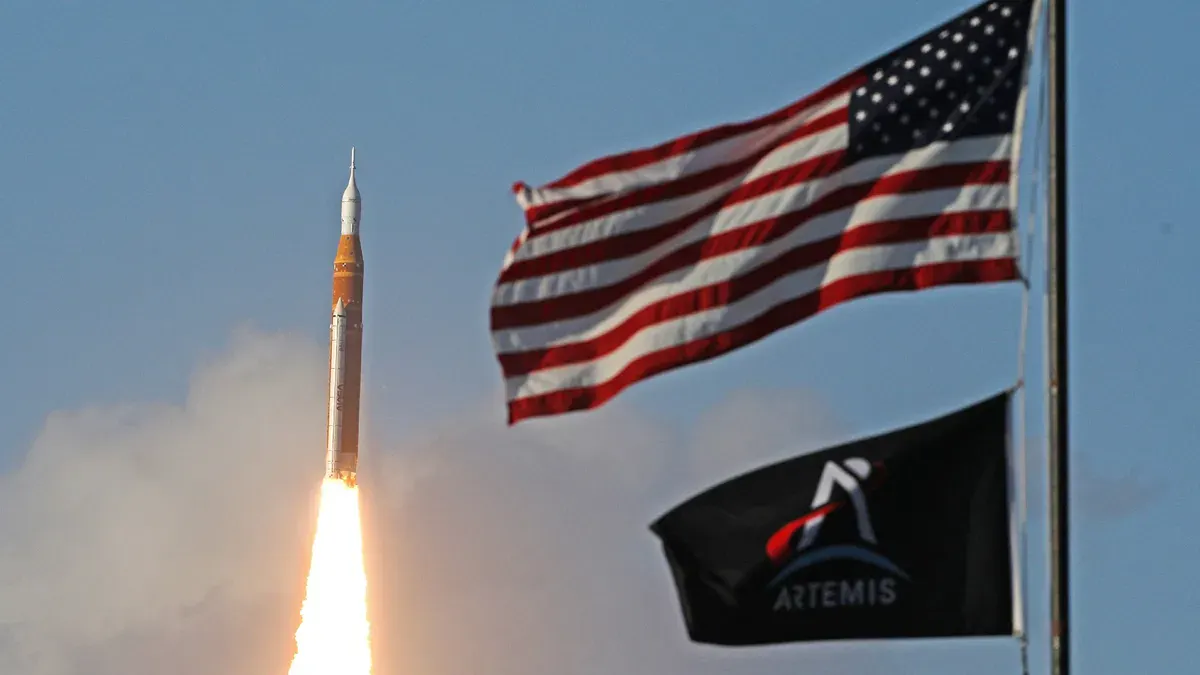
NASA successfully launched the Artemis II mission Wednesday evening, sending four astronauts on a historic journey toward the Moon, marking the first crewed lunar mission in more than 50 years and a major milestone in America’s return to deep space exploration.
Freedom Is Back
In Style
Premium domains for sale
“Let me begin by congratulating the team at NASA and our brave astronauts on the successful launch of Artemis 2 — it was quite something,” President Donald Trump said at the start of an address following Wednesday’s liftoff. “It will be traveling further than any manned rocket has ever flown … They are on the way and God bless them. These are brave people. God bless those four unbelievable astronauts.”
The Space Launch System rocket lifted off from Kennedy Space Center at 6:35 p.m. EDT, carrying NASA astronauts Reid Wiseman, Victor Glover, Christina Koch, and Canadian astronaut Jeremy Hansen aboard the Orion spacecraft. The launch followed days of final preparations and capped a buildup the White House framed as part of “America’s destiny” in space.
About an hour after liftoff, NASA Administrator Jared Isaacman underscored the significance of the moment in a brief post on X, writing, “America’s next leap is underway. Godspeed Artemis II.”
America’s next leap is underway..
Godspeed Artemis II ???????? pic.twitter.com/x87WuRm9jA— NASA Administrator Jared Isaacman (@NASAAdmin) April 1, 2026
Within minutes of liftoff, Orion reached orbit and successfully deployed its solar arrays, allowing the spacecraft to begin drawing power from the sun. Mission teams quickly transitioned the capsule into flight operations, beginning a series of system checks that will determine the next phase of the mission.
Now that Artemis II is underway, the focus shifts to what comes next. In the first phase of flight, Orion will spend roughly 24 hours in a high-Earth orbit, looping approximately 43,700 miles above the planet. This extended orbit gives astronauts and engineers time to test critical systems, including life support, deep-space communications, and the spacecraft’s maneuverability.
The crew is also expected to conduct early demonstrations of docking capabilities, an essential component for future missions. If any major issues arise during this phase, NASA retains the option to bring the astronauts home early.
Assuming systems remain stable, Orion will perform a key engine burn to push the spacecraft out of Earth’s orbit and begin its journey to the Moon. That maneuver is expected to send the crew on a three-day trajectory into what NASA calls the Moon’s “sphere of influence,” where lunar gravity begins to dominate.
During the outbound journey, astronauts will continue testing onboard systems, including next-generation spacesuits designed to sustain life for up to six days in the event of cabin depressurization, part of the mission’s broader goal of validating systems for future deep-space travel.
By Monday, the crew is expected to reach the Moon, where they will conduct a multi-hour flyby. The spacecraft will pass more than 4,000 miles above the lunar surface, offering a rare view of the Moon’s far side, regions that have never been directly observed by human eyes under these lighting conditions. From Orion, the Moon is expected to appear roughly the size of a basketball held at arm’s length.
At its farthest point, Artemis II will travel approximately 252,799 miles from Earth, farther than any human mission in history, surpassing the record set during Apollo 13.
The mission will follow a “free return” trajectory, a safety measure that uses the Moon’s gravity to naturally guide the spacecraft back toward Earth. This path ensures the crew could return home even in the event of a propulsion system failure.
Following the lunar flyby, Orion will begin its return journey, which is expected to take about four days. The mission is scheduled to conclude with a splashdown in the Pacific Ocean on April 10, where recovery teams will retrieve the crew.
NASA officials emphasized after launch that, despite its historic nature, Artemis II remains a test mission above all else. “This is a test mission,” Isaacman said during a press conference after the launch. “We’ll call it a success when they’re in the water safely, and then we’ll start working on the next mission.”
Officials also noted a minor communications issue during launch, clarifying in during the press conference that it originated on the ground and did not impact the rocket or spacecraft.
The mission builds on earlier Artemis I testing and represents a critical step toward NASA’s long-term goals: returning astronauts to the lunar surface and establishing a sustained human presence on the Moon, with eventual missions to Mars.
“This is America and our partners’ return to the Moon,” Isaacman said. For now, with a successful and safe launch, Artemis II enters its most critical phase, not just reaching the Moon, but proving that the systems designed to carry humans deeper into space are ready for what comes next.
More from this network:
Domains for Sale · GOTPeople.org · TheDSAPlatform · The Truth About Socialism
What's Your Reaction?
 Like
0
Like
0
 Dislike
0
Dislike
0
 Love
0
Love
0
 Funny
0
Funny
0
 Wow
0
Wow
0
 Sad
0
Sad
0
 Angry
0
Angry
0

I am just an average American. My teen years were in the late 70s and I participated in all that that decade offered. Started working young, too young. Then I joined the Army before I graduated High School. I spent 25 years in, mostly in Infantry units. Since then I've worked in information technology positions all at small family owned companies. At this rate I'll never be a tech millionaire. When I was young I rode horses as much as I could. I do believe I should have been a cowboy. I'm getting in the saddle again by taking riding lessons and see where it goes.
Premium domains for sale























Comments (0)