

As Fulton Sheen Gets Closer To Sainthood, Bishop Robert Barron Picks Up His Mantle
Premium domains for sale
Freedom Is Back In Style
Of the 50,000 Catholics who flocked to St. Louis, Missouri, to celebrate the beatification of Archbishop Fulton J. Sheen, only one can plausibly claim to be his successor.
Freedom Is Back
In Style
Premium domains for sale
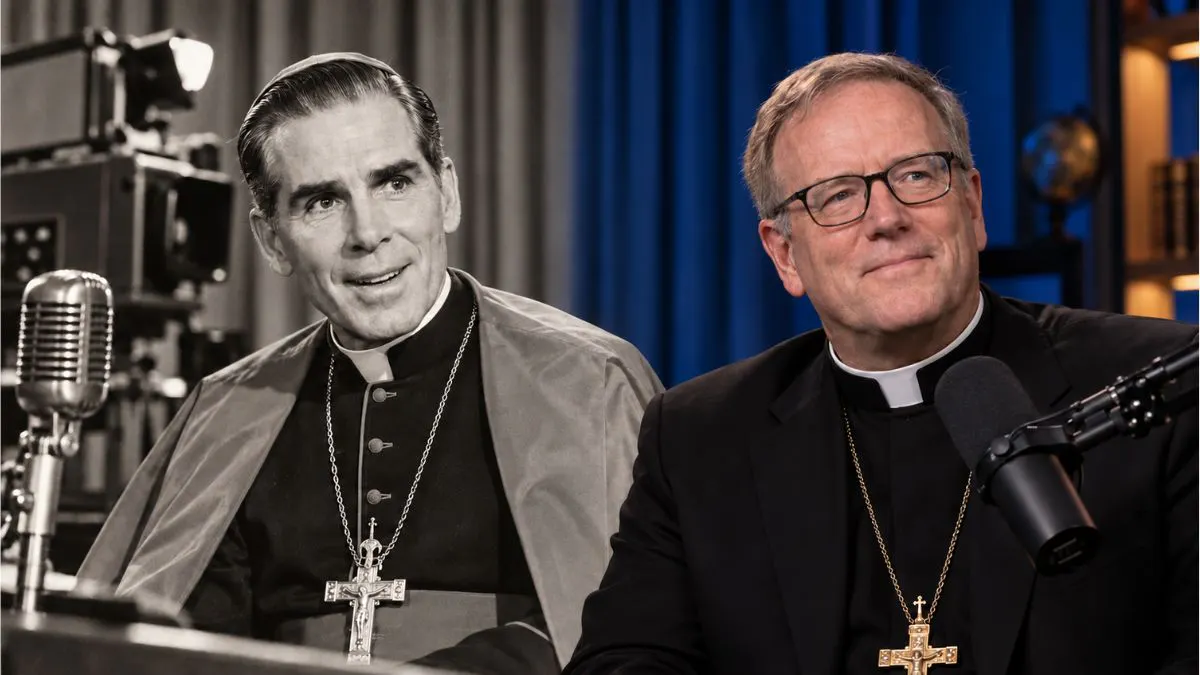
Between his Word On Fire Ministries and frequent media appearances, Bishop Robert Barron is, without question, the 21st century’s answer to Sheen, whose popular radio and television programs made him a household name in midcentury America.
Barron, the bishop of the Diocese of Winona-Rochester in Minnesota, launched Word On Fire 25 years ago as a radio program. Today, Barron sits atop a media apparatus that reaches millions of people each year. Like Sheen before him, he rose to prominence thanks to his ability to translate complex theological concepts — largely the teachings of St. Thomas Aquinas — into plain English and on popular media.
Sheen had television. Barron has podcasts.
Speaking to The Daily Wire just hours before attending Sheen’s beatification Mass, Bishop Barron reflected on Sheen, whom he called “one of the really great evangelists, communicators, and preachers of the last century.”
“In the 40s and 50s, he burst onto the scene first in radio and then television. ‘The Catholic Hour’ was his radio program in the 40s, and then ‘Life Is Worth Living,’ this famous program in the 1950s, that was more successful than Jackie Gleason and Frank Sinatra,” Barron says. “He emerged as a very significant player in the life of the American church as an evangelist, as a missionary, really.”
Barron is considerably less theatrical than Sheen, famous for delivering impassioned sermons in a booming transatlantic accent while draped in a cape and pectoral cross. But Barron is nonetheless a master of his craft. Speaking to me from somewhere in St. Louis — certainly not a proper studio — he nevertheless appeared perfectly lit, his answers seemingly calibrated to be clipped for social media, though always substantive.
When I ask him why no one before him emerged to take Sheen’s place, Barron, whether out of priestly piety or good media training, artfully elides my question. He spoke instead about the irony that the Second Vatican Council — the purpose of which “was to bring the church out from behind medieval walls and to get it into dialogue with the world” — instead caused the church to “turn inward” and debate with itself “largely about sex and authority.”
Sheen’s task, selling a pre-conciliar church to a still largely anti-Catholic country, was almost certainly harder than Barron’s. But Sheen had one major advantage: communism. By deviating from the throne-and-altar Catholicism emanating from the Vatican in his time, Sheen made Catholicism safe for skeptical Americans by demonstrating how church and state sharpened each other as allies in their common struggle against atheist statism.
“When Sheen becomes a public advocate for Catholicism, he actually defends Americanism, which is a very weird thing for him to do,” says James Patterson, a professor at the University of Tennessee, Knoxville, and author of “Religion in the Public Square,” which deals largely with Sheen. “When he spoke of Americanism, what he meant was the church providing the moral and spiritual formation for citizens to live freely and govern themselves.”
Barron beats an almost identical drum, warning just last week that “communism is making a comeback right now in our country.” He echoed that warning to me, placing resurgent communism alongside a “culture of self-invention” devoid of objective morality as the two biggest threats to Christianity and Western civilization.
But while this message earned Sheen national fame, it earns Barron scorn, even from within his own ranks. Writing this week in the National Catholic Register, Michael Sean Winters chastised the prelate for “his selective treatment of the Church’s teachings,” which to Winters “convicts him as an apologist for the president.”
Indeed, the most common criticism of Barron is that he’s too partisan. Critics point to his service on the White House Religious Liberty Commission and appearance on conservative outlets like The Daily Wire — in addition to his willingness to engage with the culture war on social media — to say he’s more interested in scoring points with Republicans than preaching the Gospel.
Barron isn’t bothered by these criticisms.
“You preach the Gospel, you preach the faith,” he tells me. “And now some people along the political spectrum will say, yeah, I like what he’s saying there. I get it from both Left and Right. If you want to be honest about people that criticize me, I’ll find you plenty of critiques from the right. I don’t worry about that.”
“I worry about declaring the Gospel to our time,” he tells me. “I’ll let people make up their own minds about, you know, where that lies on the political spectrum,” adding with a laugh that he gets criticisms from both the Left and Right.
“My preoccupation is not getting it in some politically correct way,” he says. “I’m trying to declare Jesus to the world today in a way that the contemporary world will find persuasive.”
Patterson has a different take.
“In the early 20th century, all political parties claimed religiosity,” Patterson says. “At least when Sheen would speak to Protestants, he could speak to them over things they agree with.” Opponents of Catholicism today are not protestants, Patterson says, but the secularists of the Democratic Party and the progressive Left — and “There’s really no fertile ground for Barron to cultivate there.”
“If the Left doesn’t want to hear what Barron has to say, then he’s not going to sell them anything,” Patterson says. “What would he do? Stand outside Terry Gross’s Manhattan apartment with a bullhorn?”
Where critics see blind partisanship, Patterson sees prudence. And while he often blanches at Barron’s willingness to engage with Patrick Deneen and other figures on the so-called New Right (Patterson’s latest book, “Why Postliberalism Failed,” is a critique of this ideology), Patterson ultimately praises Barron’s outreach.
“I have considerably more tolerance for him reaching out to the base, because Christ died for them, too, you know?” he says. “They need to hear what Barron has to say. He’s a good, orthodox bishop who’s taken interest in them. I mean, who did their formation? The subreddit on ‘Hearts of Iron IV’?”
Barron understands the gravity of the task before him.
“So many young people are disaffiliating from the churches, and that’s been true for a while,” he says. But “we also have been given, I would say, by the Holy Spirit, this means to reach people that aren’t going to come to our churches and parishes. We can move into their world through social media.”
“There were a lot of people in Sheen’s time who said, no, you know, radio and television, it’s cheap, it’s superficial, it’s popular, and you’ll never be able to explain the faith properly,” Barron reflects. “He proved all that wrong because he did it in a very intellectually compelling way, and a way that was popular.”
It’s ironic — Barron would probably say providential — that Sheen’s cause for canonization, which was officially opened in 2002, hit enough snags to be delayed until today. It’s a moment where the entire Catholic Church is grappling with technology. Pope Leo XIV’s first encyclical, “Magnifica Humanitas,” deals with artificial intelligence. Just a year before Sheen’s beatification, the Church canonized St. Carlo Acutis, a millennial whose use of the internet to encourage Eucharistic devotion earned him the moniker “God’s influencer.”
If the Communion of Saints is swelling with the technologically savvy, why should the pilgrim Church on Earth shun the digital?
“We live in a fallen conflictual world,” Barron tells me. “And so any good — economic, political, cultural — it has a shadow. It can turn in a negative direction. And modern technology is the same thing.”
But “just as Saint Paul used the Roman roads and the Roman social order to his evangelical advantage, so we can use the new technology to our evangelical advantage,” Barron adds. “I’m gonna stick with the good of social media, which is more basic and fundamental than the ways it gets abused. The church has got to be in that world.”
Barron is not the only clergyman attempting to render new media unto God. There’s also Father Mike Schmitz, whose social media presence and “Bible In A Year” podcast have made him a popular figure. Unlike Barron, Schmitz has largely avoided politically charged issues, instead using social media to teach Scripture and the Catechism of the Catholic Church.
“It’s like they cut Sheen in half and you got Barron and Schmitz,” Patterson jokes, adding that “it’s great that we have priests that are taking their bearings from Fulton Sheen,” regardless of their particular approach.
Barron agrees.
“Today is very important for the American church especially, but also for the world church, because we’re drawing attention to the great virtues of this man,” the bishop says. “The purpose of beatification is not to increase his holiness or his place in Heaven, but to draw the attention of the world to him.”
There’s no clear timeline for when or if Sheen will be canonized. The Church will need to attribute at least one more miracle to his intercession, and the Pope will have to sign off. But until then, “God’s microphone” will be venerated by members of the Church he helped serve and defend — including the Bishop of the Internet.
“He’s the patron saint of this moment with new media emerging,” Barron says of Sheen. “So that the old classical evangelization, declaring the lordship of Jesus, can be done in a fresh way.”
More from this network:
Domains for Sale · GOTPeople.org · TheDSAPlatform · The Truth About Socialism
What's Your Reaction?
 Like
0
Like
0
 Dislike
0
Dislike
0
 Love
0
Love
0
 Funny
0
Funny
0
 Wow
0
Wow
0
 Sad
0
Sad
0
 Angry
0
Angry
0

I am just an average American. My teen years were in the late 70s and I participated in all that that decade offered. Started working young, too young. Then I joined the Army before I graduated High School. I spent 25 years in, mostly in Infantry units. Since then I've worked in information technology positions all at small family owned companies. At this rate I'll never be a tech millionaire. When I was young I rode horses as much as I could. I do believe I should have been a cowboy. I'm getting in the saddle again by taking riding lessons and see where it goes.
Premium domains for sale









Comments (0)