

There Is No G2: China Is Still a U.S. Adversary
Premium domains for sale
Freedom Is Back In Style
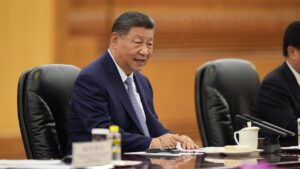
President Donald Trump is set to meet with Chinese President Xi Jinping next month for a historic bilateral meeting in Beijing. China is reportedly optimistic about the visit, hoping that U.S.-China relations can be improved after years of tension. However, caution is warranted—appearances can be deceiving.
Freedom Is Back
In Style
Premium domains for sale
Some in Washington are also optimistic, promoting the idea of a “G2”—a partnership in which the U.S. and China would jointly exercise global leadership, similar to the G7 model. President Trump himself has occasionally considered the concept.
The president can use the Beijing meeting to pursue improved relations with China. Yet achieving real progress requires clearly communicating what changes in Chinese behavior are necessary to make a rapprochement possible.
A G2 partnership is unattainable at present. China actively leverages its assets against the U.S., and the Chinese Communist Party does not seek to align its governance with American standards or values.
President Trump’s approach to the longstanding conflict with Iran has focused on prioritizing American and allied security; encouraging democratic movements within; and disrupting terrorist organizations such as the Quds Force, Hamas, and Hezbollah.
Meanwhile, China has pursued its own interests, such as buying Iranian oil and, reportedly, shipping military equipment to Iran. While President Trump has stated that China has agreed not to supply weapons to Iran, Chinese companies are exploiting the economic turmoil from the war, all while Beijing positions itself as a peacemaker—largely for economic reasons, in stark contrast to America’s tougher stance.
China does not see the Iran conflict as a chance for global security or democratic reform, but as an opportunity to antagonize the U.S. Xi Jinping, a vocal critic of Trump, recently compared America’s Iran policy to “the law of the jungle,” dismissing concerns about Iran’s nuclear ambitions and its history of violence.
For decades, the U.S. fostered a global system of peaceful trade and friendly competition. China entered this system and sought to exploit it, subsidizing domestic industries and manipulating currency to make exports cheaper, among other unfair practices.
Despite American openness since the 1970s, China has sold illicit fentanyl precursors to Mexican cartels, leading to thousands of American deaths. China also exploits U.S. openness to foreign investment and immigration, engaging in large-scale intellectual property theft that enables rapid advancement up global value chains without the costs normally involved.
Intellectual property theft is part of a broader espionage campaign targeting American ideas and state secrets. Huawei, a major Chinese tech conglomerate, is used by the Chinese state to spy on the U.S. and challenge American dominance in 5G and AI. The FBI warns that Huawei, which controls 30% of the global telecom market, poses risks even to America’s nuclear arsenal.
There is no justification for the Trump administration to stop using creative strategies to counter Chinese power. For instance, to challenge Huawei, Trump approved the merger of Hewlett Packard Enterprise and Juniper Networks, forming a new tech leader capable of competing with China in critical technologies like AI and 5G.
While mergers require careful scrutiny, some lawmakers—including Sens. Cory Booker, Amy Klobuchar, and Elizabeth Warren—alleged it was a backroom deal. Nevertheless, the U.S. intelligence community has been clear that this move will help safeguard U.S. national security and provide a strong competitor to Huawei.
President Trump has imposed tariffs on China, closed Confucius Institutes on American campuses, and called out China’s trade abuses. He has demonstrated a clear understanding of China’s long-term intentions.
President Trump is right to meet with Xi Jinping. As former U.K. Ambassador Harold Macmillan said, “jaw-jaw is better than war-war.” Still, these talks occur against the backdrop of a genuine threat to American interests from Chinese antagonism.
Earlier this month, Chinese Foreign Minister Wang Yi was asked about the idea of a G2. He responded that while China and the U.S. have significant influence, there are more than 190 countries in the world.
Wang’s remarks were not a genuine call for multilateral cooperation. Instead, they reflect China’s ongoing efforts to weaken the U.S. and undermine other nations committed to freedom and human rights.
Trust in diplomacy must always be accompanied by verification. Constructive partnership remains distant, and given China’s actions, America may be better off as a G1.
We publish a variety of perspectives. Nothing written here is to be construed as representing the views of The Daily Signal.
More from this network:
Domains for Sale · GOTPeople.org · TheDSAPlatform · The Truth About Socialism
What's Your Reaction?
 Like
0
Like
0
 Dislike
0
Dislike
0
 Love
0
Love
0
 Funny
0
Funny
0
 Wow
0
Wow
0
 Sad
0
Sad
0
 Angry
0
Angry
0

I am just an average American. My teen years were in the late 70s and I participated in all that that decade offered. Started working young, too young. Then I joined the Army before I graduated High School. I spent 25 years in, mostly in Infantry units. Since then I've worked in information technology positions all at small family owned companies. At this rate I'll never be a tech millionaire. When I was young I rode horses as much as I could. I do believe I should have been a cowboy. I'm getting in the saddle again by taking riding lessons and see where it goes.
Premium domains for sale








Comments (0)