

Victor Davis Hanson: The Problem With America’s Military Arsenal
Premium domains for sale
Freedom Is Back In Style
Editor’s note: This is a lightly edited transcript of today’s video from Daily Signal senior contributor Victor Davis Hanson. Subscribe to our YouTube channel to see more of his videos.
Freedom Is Back
In Style
Premium domains for sale
This is Victor Davis Hanson for the Daily Signal.
We’re in the eighth month of an on-and-off war, as we all know, with Iran, and since 2022, we have been watching Ukraine and Russia fight, and we have been supplying Ukraine. And one of the problems with these multifront wars, and we have been conducting operations against Iran as well as helping Israel supply its forces against the Houthis, Hamas, Hezbollah.
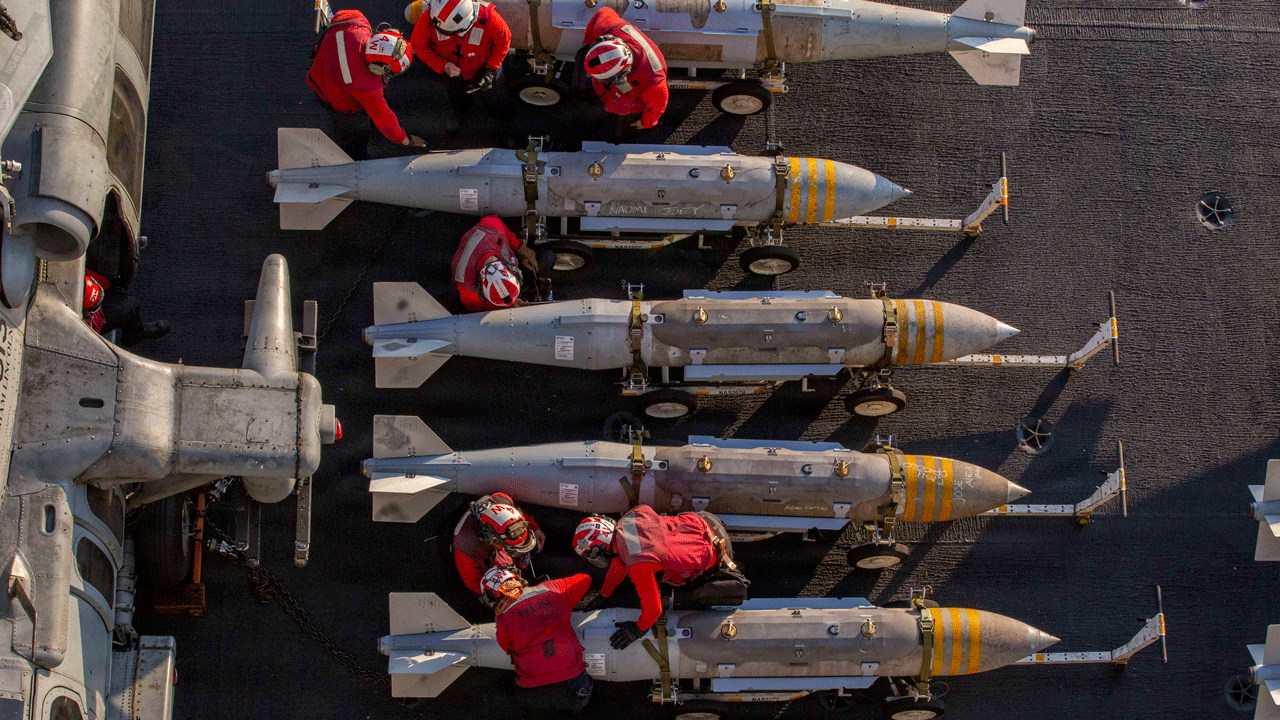
Part of the problem is that in Ukraine, in Iran, in the Middle East, we have now, because of the use, cut our inventories of Patriot missiles by about 25% or 30%. And remember, we export them all over the Western world, and our Hellfire and Tomahawk missile inventories are cut by 50%.
And the problem is even greater than the erosion of our safety net because if we would have a problem with Taiwan or elsewhere in the world, we would be in trouble.
But the Patriot missile costs about $4 million and $4 million-plus, per missile. The Hellfire is shot by a plane, about $150,000, $200,000. The Tomahawk is about $3 million to $4 million.
So what I’m getting at is our enemies, whether in Iran or the enemies that are trying to squeeze Israel or the Russians that we supply Ukraine to fight, they are using cheaper drones, and some of them are only $5,000 or $6,000.
So in a cost-benefit analysis, we’re spending 10, 20, 30 times more to knock them down. And I know that we’re gonna—we’re in an evolutionary spiral where we can update electronic warfare, jamming, lasers. That’s all coming.
But right now, we have kind of a problem, and our Reaper, our really premium Reaper drones and remnants of the Predator drones, we’ve lost about 25% of those.
Those are several million dollars.
This year, Ukraine will produce, when 2026 is over, a million drones. We’re really trying to ramp up production, and we’ll probably only do 50,000 at most. And we are galvanizing, but even next year, we don’t think we could make more than 300,000.
Look elsewhere what we have, though.
We have 11 of the best, biggest carriers in the world, but they cost $13 billion just to produce them, not even to maintain and run them. We have the wonderful B-2, the most stealthy bomber in the world with the biggest payload, but it’s $2 billion, and we only have about 20 of them.
The B-1 dates from the Reagan era. It’s a wonderful bomber, but it costs $315 million each, and we only have about 45. And when you get the slightest threat that Iranian agents may be sending drones into an RAF U.S. base in the UK, and we can’t defend it, we have to take all 11 and send them back home, or we might lose $3 billion of inventory.
The F-35 is a wonderful plane. They’re $90 million apiece. We only have 400 of them. The best plane in some ways, the interceptor F-22, is $140 million each, and we only have 195. How could you have more at that cost?
What I’m getting at is this is not how we won in Korea, but especially in World War II. The idea was we were not going to…
When we rearmed, and we started the war with number 19 in size of our army and almost virtually no air force to speak of except some B-17s and out-of-date fighters. We had a good Navy, but the idea was we were not going to try to match the Germans or the Japanese necessarily, in the quality of each particular plane.
We were not going to build a Panther or Tiger tank that was indomitable as far as the power of its gun, and the armor, but would be produced in very limited, at 5,000 or 6,000 Panthers to a little over 2,000 Tigers. We were going to do something different. We were gonna produce 50,000 Sherman tanks.
Pretty good tanks. 10 hours on the road, one hour maintenance. Not like the Tiger or Panther, one hour maintenance, one hour on the road. Easy to maintain. Very crew adaptable. If they were hit, you could drop out on the bottom through a trapdoor. Three out of five of destroyed Sherman crewmen escaped with their lives.
We created 300,000 aircraft. 300,000, DC-3s, bombers, fighters. 35,000. 35,000 B-17s, B-24s and B-29 heavy bombers. One an hour at the Willow Run plant run under the auspices of the Ford family. 9,000 warships, if you count smaller landing craft. 140 aircraft, not 11, 140 of fleet, light and escort.
And how did that happen? Well, we enlisted, kind of like Donald Trump is doing with our own war production renaissance, where he’s bringing in techies, like Elon Musk or the Anduril people or the AI people, but who are often of the opposite political persuasion.
But World War II, we brought in the GM CEO, William Knudsen.
We brought in the aluminum king, Henry Kaiser. We brought in Henry Ford, the car baron. And we said, basically, we’re in trouble, and we may not be able to have the craftsmanship right now of a Japanese Zero or a Bf 109, or we may not have a V-1 pretty soon. But we can outproduce these people with very good weapons so that when we’re on the battlefield, there’s five, six, 10 Sherman tanks for one or two of the German tanks.
And they’re gonna run, and they’re not gonna break down. And you can pull the engine, the transmission in a few hours, not two days. And we’re gonna produce a greater GDP than all the belligerents in the world. Our Navy is gonna have more ships than all the ships in the world. Both happened by 1945.
So in other words, we’re not gonna make the perfect the enemy of the good.
Now, does that have lessons? Because obviously we won World War II within four years. I think it does.
And I think we’re starting to see that a little bit in the Department of War today. There is an emphasis that while a Northrop, a General Dynamics, a Lockheed, a Raytheon with their huge budgets and their expensive, I guess what the word would be, exquisite platforms are necessary, they have to be complemented by quantity.
So we don’t use $4 million missiles to shoot down a $5,000 Yemeni drone whose sole intention is to exhaust our inventories until they’re down at 10%, and then they will really unload on us. So what we all need to do as American citizens is support this reform effort, and it’s going to be multidimensional.
We don’t want just the type of lobbyist or insider Washington relationships as far as procurement and the Pentagon from former employees, all of that stuff. We need to get everybody involved and say, “Each company, according to your station, think of ways where you can combat drones or missiles or rockets or shoot things down inexpensively and create a lot of these platforms and weapons,” because we are reaching a very critical and dangerous period that we have to get through.
We have the existential threats of China. We have the traditional threat of Russia in a land war with our NATO allies. We have Iran and its effort to get a bomb and this standoff we’re dealing with. We have the enemies that surrounded Israel that are our enemies in an unstable …
And one thing we need is not just a few platforms or a few weapon systems that can be easily taken out and then exhaust our inventories, but we need really good weapons, if sometimes the best here, but maybe not always the best in the world.
One thing is we have more of them than the enemy, and we do the swarming, not our enemies.
We publish a variety of perspectives. Nothing written here is to be construed as representing the views of the Daily Signal.
More from this network:
Domains for Sale · GOTPeople.org · TheDSAPlatform · The Truth About Socialism
What's Your Reaction?
 Like
0
Like
0
 Dislike
0
Dislike
0
 Love
0
Love
0
 Funny
0
Funny
0
 Wow
0
Wow
0
 Sad
0
Sad
0
 Angry
0
Angry
0

I am just an average American. My teen years were in the late 70s and I participated in all that that decade offered. Started working young, too young. Then I joined the Army before I graduated High School. I spent 25 years in, mostly in Infantry units. Since then I've worked in information technology positions all at small family owned companies. At this rate I'll never be a tech millionaire. When I was young I rode horses as much as I could. I do believe I should have been a cowboy. I'm getting in the saddle again by taking riding lessons and see where it goes.
Premium domains for sale













Comments (0)