

Who makes the Waymos flooding American streets? China.
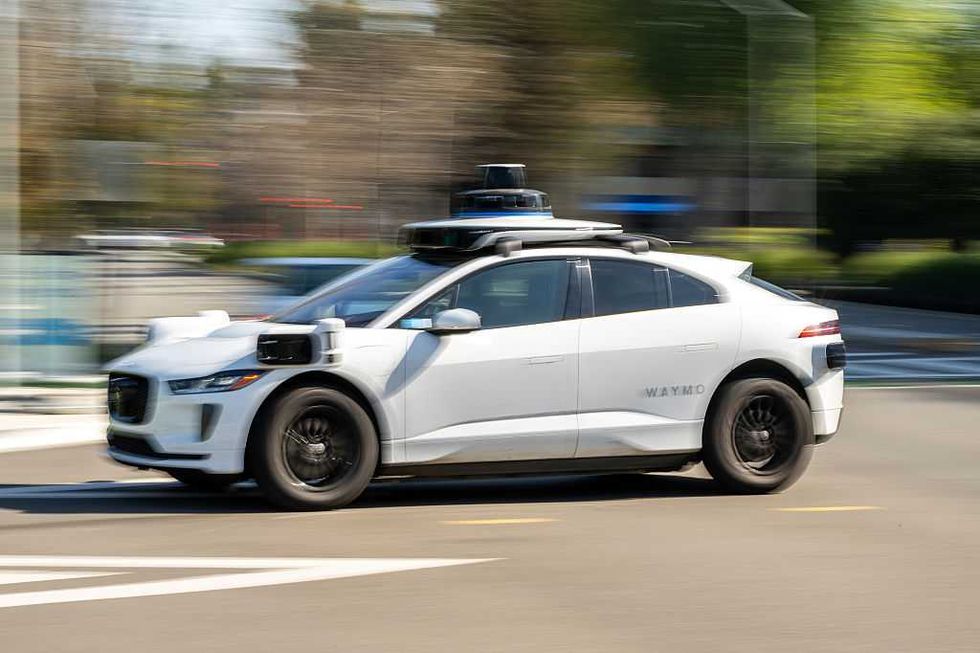

Governor Kathy Hochul recently slowed, but did not stop, Waymo's march into New York, blocking expansion beyond city limits while leaving the door wide open inside them.
Live Your Best Retirement
Fun • Funds • Fitness • Freedom
These aren't simply cars without drivers. Waymo's robotaxis are mobile intelligence machines. They map infrastructure, catalogue faces, record ambient sound, and track movement patterns across entire cities — continuously and autonomously. Unlike a fixed security camera or an app you can delete, these vehicles move freely through neighborhoods, past hospitals, around government buildings, silently collecting everything in their path. The data never sleeps, and the cars never stop.
China's strategy for technological dominance is anything but subtle.
No small matter, then, that Waymo's next-generation fleet is manufactured by Zeekr, a Chinese electric vehicle company with deep, documented ties to China's Communist Party. Zeekr is a subsidiary of Geely, one of China's most powerful automotive conglomerates — a company that operates, as all major Chinese corporations must, in full alignment with Beijing's strategic interests. Under Chinese national security law, any firm can be compelled to hand its data to the state. No appeal, no refusal. No exceptions.
Zeekr carries the fingerprints of a government that has spent decades playing a patient, precise long game, embedding itself in Western supply chains, Western infrastructure, and now Western streets. Part of the Zhejiang Geely Holding Group, an automotive behemoth with stakes in Volvo, Polestar, and other Western car companies, Zeekr took off with significant state backing via the Yuexiu Industrial Fund and the Xin'an Intelligent Manufacturing Fund. Zeekr benefits from CCP-linked subsidies, even abusing the system to inflate sales, and exists within a corporate ecosystem where the line between private enterprise and party directive is deliberately blurred.
Hiding in plain sight
When the Waymo-Zeekr connection began attracting serious scrutiny, Waymo's response was telling. Rather than address the security concerns directly, the company quietly rebranded the vehicles — scrubbing Zeekr's name from its marketing materials entirely. "Waymo’s official explanation," TechCrunch reported, "is that the company determined the U.S. public isn’t familiar with the Zeekr brand," adding that, "of course, in the U.S. it might not hurt to ditch the name of a Chinese automaker either." The cars didn't change. The supply chain didn't change. The data architecture didn't change. Only the name did.
But China's own strategy for technological dominance has been anything but subtle. Huawei was waved into Western telecommunications networks for years before governments finally acknowledged the obvious. TikTok spent the better part of a decade harvesting behavioral data on hundreds of millions of Americans while its ultimate obligations remained rooted in Beijing. The playbook is consistent: embed early, expand endlessly, extract continuously.
Waymo's robotaxis are the next chapter. Former CIA analyst Sen. Elissa Slotkin (D-Mich.)) cut straight to it when asked about Chinese autonomous vehicles operating on American roads: "I know what I would do with that data if I was at the Pentagon." From someone who spent years inside America's intelligence apparatus, that is a warning worth taking seriously.
Utopia with Chinese characteristics
That's on top of the more, shall we say, pedestrian dangers. A Waymo vehicle recently struck a child in Santa Monica, exposing the technological fallibility that the industry and its urban density-obsessed allies prefer to obscure. When they do fail, as some inevitably will, there is no driver to bear responsibility, no human instinct to override an algorithm in a fraction of a second.
RELATED: Hollywood lawyers up against Chinese AI 'slop' as Seedance 2.0 sweeps the internet
 Photo by Jonathan Raa/NurPhoto/Getty Images
To be sure, robotaxi advocates are right to observe that taking humans out of the driving loop likely leads overall to significant reductions in accidents. There's a certain tempting logic to the riddle of improving our quality of life by taking ourselves out of the loop. But when you're actually just looping out Americans, leaving Chinese humans with the goods and the control, what becomes of that utopian vision? A child struck by a robotaxi, as serious as that is, remains a local tragedy. A foreign government harvesting precise, continuous intelligence on American cities, American citizens, and American infrastructure is a national security crisis — one unfolding in slow motion, in plain sight, with a Waymo logo on the door.
Why hack America's surveillance systems when you can drive right through them? To allow cars manufactured by a company with direct ties to Beijing to roam freely on American streets is, at best, breathtaking naivete. At worst? It's the most efficiently delivered intelligence haul since the Cold War, although China's own Typhoon hacks are a very close second.
Elon to the rescue?
While Waymo shamelessly rebadges CCP-aligned hardware and hopes no one looks too closely, Elon Musk has recently announced via a post on X that the Tesla Cybercab will retail for under $30,000 before the end of next year. It's American-designed, American-developed, built without Beijing's fingerprints anywhere in the supply chain. The autonomous future doesn't have to arrive with a foreign intelligence apparatus riding shotgun. If America intends to remain the greatest nation on earth, it should probably stop subcontracting its surveillance vulnerabilities to the country most eager to exploit them.
Sadly, New York is not alone in this reckless endeavor. California has welcomed Waymo with equal enthusiasm and equal indifference to what's underneath the hood. Together, two of America's largest, most strategically significant states are rolling out the red carpet for a fleet built by companies that answer to a foreign flag. Both can still course-correct. Both can demand honest answers — about the hardware, the software, the data flows, and the loyalties embedded in every vehicle they've so eagerly waved through.
The Trojan horse isn't somewhere outside the gates. It's right at the curb, with a five-star rating and a pickup time of four minutes.
What's Your Reaction?
 Like
0
Like
0
 Dislike
0
Dislike
0
 Love
0
Love
0
 Funny
0
Funny
0
 Wow
0
Wow
0
 Sad
0
Sad
0
 Angry
0
Angry
0

I am just an average American. My teen years were in the late 70s and I participated in all that that decade offered. Started working young, too young. Then I joined the Army before I graduated High School. I spent 25 years in, mostly in Infantry units. Since then I've worked in information technology positions all at small family owned companies. At this rate I'll never be a tech millionaire. When I was young I rode horses as much as I could. I do believe I should have been a cowboy. I'm getting in the saddle again by taking riding lessons and see where it goes.
















Comments (0)