

Why Venezuelans Are Dancing In The Streets
Daniel DiMartino is a fellow at the Manhattan Institute, one of the best think tanks in the country. But what qualifies him to write this piece is not his Ivy League economics degree, but rather the fact that he grew up in Venezuela, where he had a front-row seat to the brutal consequences of socialism.
Live Your Best Retirement
Fun • Funds • Fitness • Freedom
DiMartino is just one of the millions of Venezuelans that fled Nicolas Maduro’s regime and were jubilant this weekend after the world learned that the United States had removed Maduro from power. I mean, just listen to the joy in his voice as he reacted to the news early Saturday morning. After hearing that, we knew we needed him to explain that joy to our audience at The Daily Wire.
For DiMartino, thee joy is not about getting revenge on Maduro. it’s about hope for the future of Venezuela. We hope you enjoy. —Brent Scher
***
Venezuelans throughout the world are celebrating after this weekend’s perfectly executed U.S. military operation which captured narco-terrorist tyrant Nicolas Maduro. The morning I woke up to the news of Maduro’s capture was one that I had been dreaming of for my entire life as a Venezuelan who suffered under his regime.
This move by President Trump and his team provides justice, advances America’s and Venezuela’s interests, and could unleash prosperity like we have never seen before in the Western Hemisphere.
Venezuela has been ruled by Maduro’s socialist regime since I was born in 1999. The regime pillaged what was once the richest nation in Latin America. Millions of Europeans in the 1940s and 1950s sought opportunity in places like Caracas in the aftermath of World War II. Millions of Colombians crossed the border to Venezuela for safety from narco-terrorist Marxist guerrillas from the 1970s until the 1990s. Lebanese and Syrian Christians escaped to Venezuela in the 1960s after the Assad family’s takeover. And Americans routinely traveled to Venezuela for tourism and investment opportunities.
After more than two decades of a socialist regime that started out democratically and gradually took absolute power and rigged elections to remain in charge, Venezuela is starving. The country that once drew immigrants and exported oil bled millions of refugees and imports its own gasoline. The Maduro regime, once it ran out of oil, gold, and companies both foreign and domestic to steal, turned to drug trafficking to profit and fund their repression system.
Venezuela, if governed well with a free market economy, has the potential to be wealthier than nations like the United Arab Emirates or Kuwait. It has more oil and it is better positioned, both culturally and geographically.
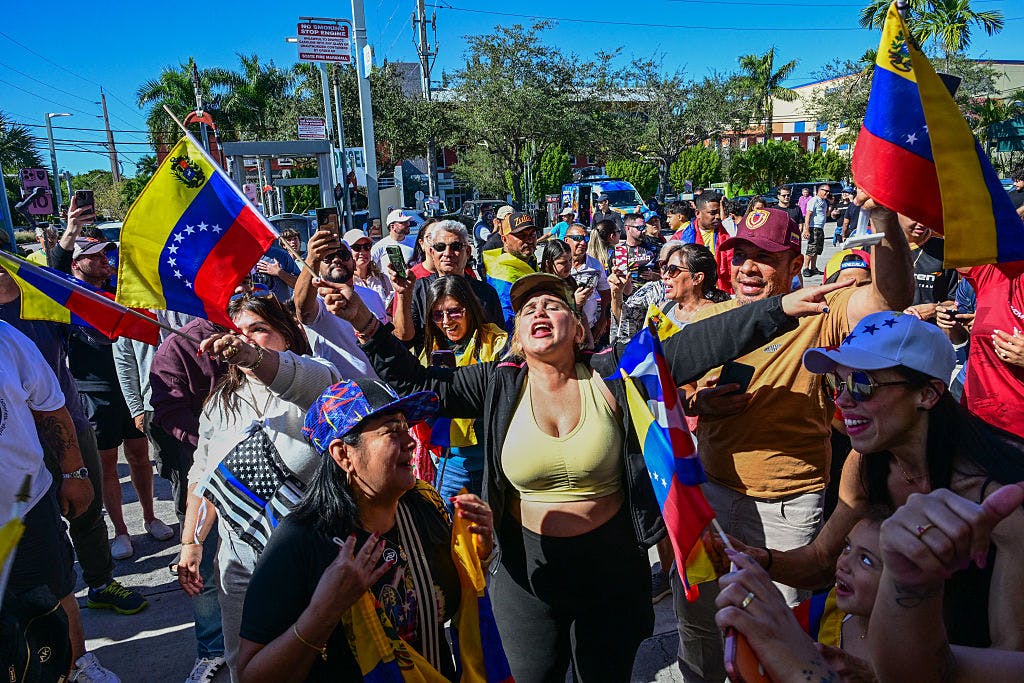
That should explain why Venezuelans abroad are celebrating openly on social media and in the streets, with mass gatherings spotted all over the United States, but especially in the heart of the Venezuelan diaspora of Miami. Celebrations were held in Argentina, Peru, Colombia, Spain, and Chile, among other countries. The nine million strong Venezuelan diaspora forced into exile by socialism is celebrating this way because we know who Maduro is. We know what his regime did to our families, our economy, and our future. And we know that this moment, however fragile, represents something we were told we would never see: freedom and justice.
What Venezuelans feel today is not bloodlust or vengeance. It is relief. It is gratitude. And above all, it is hope. Gratitude toward the United States, a country that did not throw in the towel when diplomacy, sanctions, and international pressure all failed. Gratitude toward an America willing to defend its own interests while also standing on the right side of history. Gratitude to President Trump for following through on his promise, to Secretary of State Marco Rubio for standing for his values when it mattered, and to Secretary of War Pete Hegseth and all the U.S. servicemen involved who executed an operation perfectly.
The Trump administration understands something many foreign-policy “experts” refuse to admit: Maduro never would have left power voluntarily. He only understands force. He could have chosen the easy life with all the stolen wealth in Moscow, but instead he opted for a New York City jail. Such is life.
But this victory does not mean the danger is over.
As Secretary Rubio acknowledged in multiple interviews, Maduro’s capture, while historic, does not instantly dismantle a criminal system that has entrenched itself in every institution of the Venezuelan state. His regime was never a one-man dictatorship; it is a narco-state network that includes generals, intelligence officials, judges, governors, and foreign terrorist allies. Tren de Aragua, Cuban spies, and Iranian operatives did not disappear overnight. The Venezuelan people inside Venezuela are happy, but scared of the regime.
The next phase matters just as much as the operation itself. A successful transition in Venezuela must be orderly but also relatively fast. The oligarchs in power: Delcy Rodriguez, the nominal vice president, her brother Jorge Rodriguez, Diosdado Cabello, and Vladimir Padrino Lopez, all participate in drug trafficking, terrorism, and are under sanctions and U.S. Department of Justice indictment.
The remaining Maduro cronies in power have the chance to do the right thing. One sign of a good faith transition in the coming weeks will be the release of hundreds of political prisoners, among them my friend Maria Oropeza, a young woman whose “crime” was observing election fraud and leading the opposition in her state. The other sign would be the puppet Supreme Court declaring an “absolute absence” of the president, which would trigger elections according to the socialist constitution. Such elections would allow the most popular leader in the country, Maria Corina Machado, to run, and she would win them by a landslide.
Only with a government led by Machado and not Maduro stooges can the United States guarantee that private oil companies will fork over the billions in investment required to revitalize the oil, electric, and water infrastructure. Exxon, Conoco Phillips, Shell, and BP won’t invest in a country whose government may take their property as soon as Trump leaves office, which is exactly what will happen if a transition isn’t finished by the time the Trump administration ends.
Economically, the upside of success in Venezuela is extraordinary. A post-Maduro Venezuela could become the greatest growth story in the Western Hemisphere’s history. With secure property rights, a privatized oil sector, and a free-market framework, Venezuela could once again attract global investment. Returning to pre-socialism oil production would mean three million barrels of oil per day in additional global output, lowering energy prices for everyday Americans.
A free and prosperous Venezuela would welcome millions of its people back home, stabilizing an entire region overwhelmed by mass migration. It would also weaken criminal networks like Tren de Aragua, reducing the flow of drugs and gang violence into the United States, saving American lives.
This is why President Trump’s decision was not just moral, it was strategic.
Critics predicted catastrophe, imperialism, and endless war. They have been wrong about Venezuela for 25 years, and about Trump for his entire political career. They were wrong when they excused Chávez. Wrong when they normalized Maduro. Wrong when they claimed sanctions alone would work. And wrong now, as they once again ignore the voices of actual Venezuelans in favor of “international law.”
I pray that history will remember this weekend as the moment the world’s longest-running socialist experiment collapsed under the weight of its crimes. For Venezuelans, it is the first real chance to rebuild a country that once welcomed the world, and can do so again.
Justice is here. Freedom is within reach. For the first time in my life, Venezuela’s future feels brighter than its past. I wish that so many people, including my immigrant grandparents, were alive to see this.
Thank you President Trump.
Daniel DiMartino is a fellow at the Manhattan Institute.
The views expressed in this piece are those of the author and do not necessarily represent those of The Daily Wire.
What's Your Reaction?
 Like
0
Like
0
 Dislike
0
Dislike
0
 Love
0
Love
0
 Funny
0
Funny
0
 Wow
0
Wow
0
 Sad
0
Sad
0
 Angry
0
Angry
0

I am just an average American. My teen years were in the late 70s and I participated in all that that decade offered. Started working young, too young. Then I joined the Army before I graduated High School. I spent 25 years in, mostly in Infantry units. Since then I've worked in information technology positions all at small family owned companies. At this rate I'll never be a tech millionaire. When I was young I rode horses as much as I could. I do believe I should have been a cowboy. I'm getting in the saddle again by taking riding lessons and see where it goes.






Comments (0)