

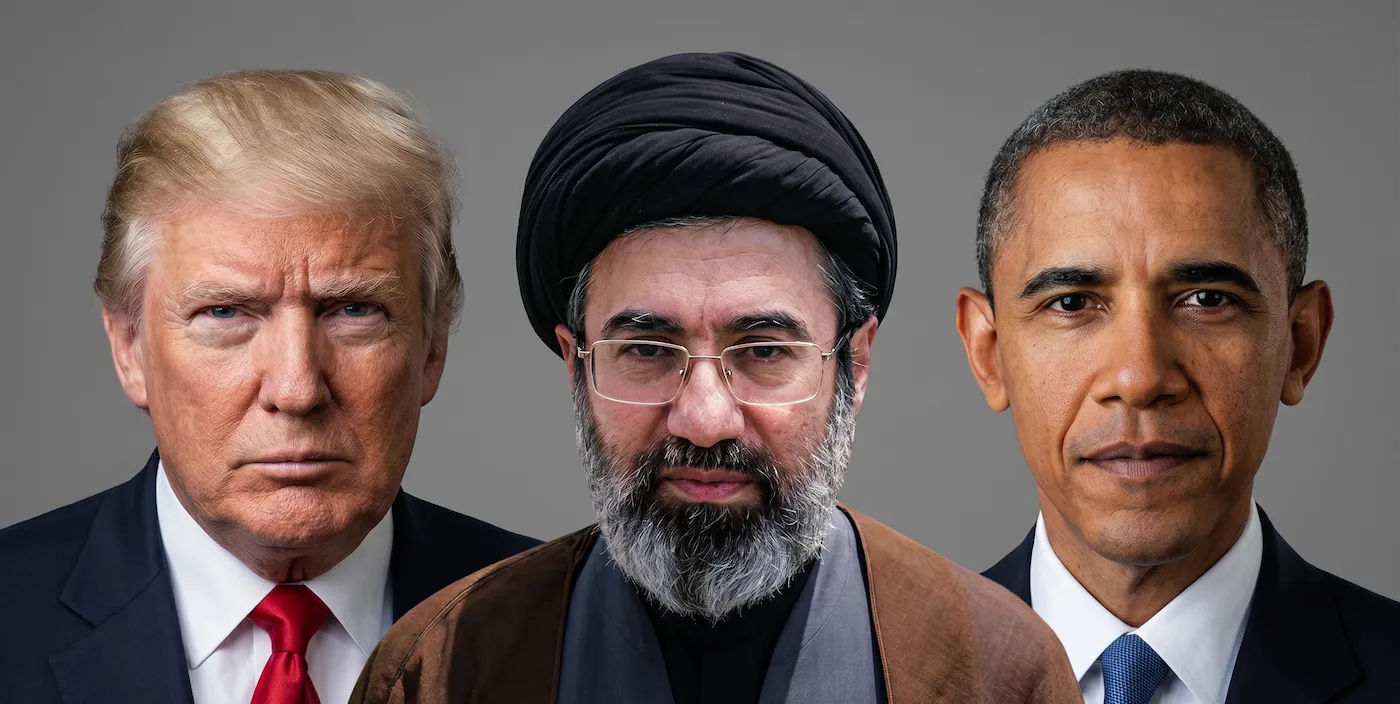
How Does Trump’s Iran Deal Compare To Obama’s? Here’s What We Know.
Premium domains for sale
Freedom Is Back In Style
When Donald Trump launched his first presidential campaign, he pledged to withdraw the United States from the Joint Comprehensive Plan of Action, President Barack Obama’s nuclear agreement with Iran.
Freedom Is Back
In Style
Premium domains for sale
Trump issued a statement condemning the JCPOA as “very dangerous” shortly after it was finalized on July 14, 2015. The president never dropped his opposition, pulling out of the deal in 2018.
Now, the president is preparing to unveil his own “Memorandum of Understanding” with Iran — the text of which has not been released, but which the White House says Trump has virtually signed. Officials say the memorandum is just the first step in a broader process. Following its signing, negotiators are expected to enter a roughly 60-day period of “technical talks” aimed at finalizing implementation details relating to the nuclear issues, suggesting that some of the most consequential questions are still not resolved.
Still, the question remains: how does the deal Trump spent years attacking compare with the agreement his own administration now appears to be pursuing?
Let’s dive in.
Uranium Enrichment And Sunsetting
The JCPOA: Trump’s central objection to the Obama deal was that it did not eliminate Iran’s enrichment program, saying “the deal allowed Iran to continue enriching uranium and, over time, reach the brink of a nuclear breakout.
The JCPOA capped enrichment at 3.67% and sharply limited Iran’s stockpile of enriched uranium, but it did not require Iran to dismantle its enrichment infrastructure. The deal’s restrictions on Iran’s nuclear activities also expired over time, gradually allowing the Islamic Republic to enrich uranium, build and run centrifuges, and build nuclear stockpiles.
“The agreement was so poorly negotiated that even if Iran fully complies, the regime can still be on the verge of a nuclear breakout in just a short period of time,” Trump said.
The Trump Deal: As recently as April, Trump claimed there would be “no enrichment of Uranium” under a future agreement. But Trump said Sunday that he was open to an arrangement under which Iran suspends enrichment for 15 years, though he emphasized that negotiations remain ongoing.
Trump also said Iran would be permanently restricted to low levels of enrichment for civilian purposes, but would not say whether that limit would match the JCPOA’s 3.67% enrichment cap — only that the restrictions would apply “forever.”
Another unresolved question is the fate of Iran’s existing stockpile of enriched uranium. Administration officials have indicated that the issue remains under discussion, though details about whether the material would be removed from Iran, diluted, transferred to a third country, or otherwise disposed of have not yet been released.
Sanctions And Economic Relief
The JCPOA: Trump argued that the Obama administration surrendered its strongest leverage by lifting economic sanctions and providing Iran access to frozen assets in exchange for what he viewed as temporary nuclear restrictions.
The president frequently cited the estimated $150 billion in frozen Iranian assets that became available after implementation of the agreement and argued the regime used those resources to strengthen itself.
“In other words, at the point when the United States had maximum leverage, this disastrous deal gave this regime — and it’s a regime of great terror — many billions of dollars, some of it in actual cash — a great embarrassment to me as a citizen and to all citizens of the United States,” Trump said in 2018.
Trump also often criticized a separate Obama administration settlement involving a decades-old dispute over military equipment purchased by Iran before the 1979 Islamic Revolution. The day after the JCPOA was implemented, the United States and Iran announced an agreement returning $400 million in principal from a pre-revolution foreign military sales trust fund, along with approximately $1.3 billion in interest.
The initial $400 million payment was flown to Tehran in cash aboard a cargo plane, a fact that Trump cited as evidence of Obama capitulating to the Iranian regime.
“The Iran deal is a terrible deal. We paid $150 billion. We gave $1.8 billion in cash. That’s actual cash, barrels of cash. It’s insane. It’s ridiculous. It should have never been made,” Trump said in 2018.
The Trump Plan: The memorandum reportedly leaves open the possibility of sanctions relief, access to frozen Iranian funds, and potential foreign investment if Iran complies with its commitments. But White House officials stressed that all relief would be based on Iranian compliance.
“We don’t pay for play,” one official said. “You can’t give them access to their funds or release funds to them if they’re just going to use that money to fund terrorism and cause more instability in the region.”
The agreement could eventually allow countries such as Qatar, Saudi Arabia, and the United Arab Emirates to invest in Iran, while also providing Tehran greater access to the global economy.
During a call with reporters, one senior administration official said the memorandum discusses “the possibility of releasing frozen funds, sanctions relief” and a potential “$300 billion fund to rebuild their country.”
Vance on Tuesday rejected reports that the agreement would immediately provide Iran with hundreds of billions of dollars in benefits, saying “Not a single cent of American money under any circumstance, no matter what the Iranians do, goes to Iran.”
The administration has presented that approach as a key distinction from the JCPOA, which Trump argued provided Iran with significant economic relief before securing lasting changes in the regime’s behavior.
Iran’s Missile Program
The JCPOA: Trump repeatedly criticized Obama for failing to address Iran’s ballistic missile program, arguing that restricting uranium enrichment alone was insufficient if Tehran continued developing them as a means to deliver a nuclear weapon.
“Not only does the deal fail to halt Iran’s nuclear ambitions, but it also fails to address the regime’s development of ballistic missiles that could deliver nuclear warheads,” Trump said when announcing the U.S. withdrawal from the agreement.
Trump argued that any future agreement should eliminate “the threat of Iran’s ballistic missile program” alongside the nuclear threat itself.
The Trump Plan: Administration officials have not publicly detailed whether the memorandum requires limits on Iran’s missile program, leaving one of Trump’s most persistent criticisms of the JCPOA unresolved for now.
Iran says that maintaining its ballistic missile program is non-negotiable. But Israel continues pushing for strict limits. Israeli Prime Minister Benjamin Netanyahu said earlier this month that although Israel is not a party to the memorandum of understanding, it expects any final agreement to restrict missile production, dismantle enrichment infrastructure, remove enriched material, and halt Iran’s proxy support.
Meanwhile, Trump appeared to soften his tone on Iran’s missiles during a May radio interview with conservative host Hugh Hewitt. When asked if requiring Iran to cap its missile program and permit intrusive inspections constituted a strict red line, Trump signaled flexibility.
“Look, missiles are bad, but yeah, and they do have to cap it, but this is about they cannot have a nuclear weapon,” Trump said.
Terrorist Proxies
The JCPOA: According to Trump, Obama failed to address Iran’s broader behavior throughout the Middle East, including funding its terrorist proxy groups.
He criticized the agreement for failing to constrain Iran’s support for groups such as Hezbollah, other regional proxies, and its involvement in conflicts in Syria and Yemen, arguing that sanctions relief enabled Tehran to expand those activities.
“Once sanctions were lifted, the regime used its new funds to build nuclear-capable missiles, support terrorism, and cause havoc throughout the Middle East and beyond,” he said in 2018.
The Trump Plan:
Senior administration officials said Monday that any agreement with Iran would pair economic incentives with broader changes in Tehran’s behavior, including curbing its support for terrorism and regional instability.
During a call with reporters, a senior administration official said Trump is willing to “reset the relations” with Iran and give the country an opportunity to reach its “full potential,” but only if Tehran “verifiably cut[s] out the pathways that they’ve been pursuing towards nuclear weapons, funding terrorism, and causing regional instability.”
Vance offered a more specific example Tuesday, indicating that Iran’s support for Hezbollah could jeopardize any economic benefits contemplated under the agreement.
Asked by Megyn Kelly whether the United States would continue providing economic relief if Hezbollah continued attacking Israel, Vance said “If Iran is funding Hezbollah, we’re not going to allow a bunch of unfrozen assets to [flow] to the Iranians.”
The comments suggest the administration is seeking commitments that extend beyond Iran’s nuclear program, though officials have not publicly detailed what specific requirements related to Hezbollah, other Iranian-backed groups, or regional activities might ultimately be included in the final agreement.
Americans Imprisoned In Iran
The JCPOA: Trump slammed the Obama administration for failing to secure the release of Americans detained in Iran, arguing that the United States should have used its negotiating leverage to obtain their release.
Five American prisoners were released on the day the JCPOA was implemented on January 16, 2016, including Jason Rezaian, the Washington Post’s Tehran bureau chief, though the releases were not directly in the JCPOA.
The United States also granted clemency, commuted sentences, or dropped charges against seven Iranians, which Trump said was tantamount to paying a ransom for American prisoners.
The Trump Deal: It is unclear whether the agreement addresses the Americans currently detained by Iran.
At least six American citizens or permanent residents are believed to be imprisoned in Iran, including journalist Reza Valizadeh and New York jeweler Kamran Hekmati. The State Department designated Hekmati as wrongfully detained earlier this year.
Where Things Stand
One major difference between today’s negotiations and those that produced the JCPOA is the state of Iran’s nuclear program.
While Trump has repeatedly said his primary objective is ensuring that Iran never obtains a nuclear weapon, Iran has long insisted that its nuclear program is peaceful and has frequently cited a fatwa issued by Supreme Leader Ayatollah Ali Khamenei declaring nuclear weapons forbidden under Islamic law.
Yet Tehran has repeatedly faced accusations from Western governments and international watchdogs of concealing aspects of its nuclear activities and pursuing capabilities that could shorten its path to a bomb.
When the JCPOA was signed in 2015, Iran agreed to cap uranium enrichment at 3.67% purity and limit its stockpile to 300 kilograms. In the years that followed, however, Tehran significantly expanded its nuclear activities.
A February 2025 report from the International Atomic Energy Agency found that Iran’s uranium stockpile is enriched to 60 percent purity — close to the 90% level considered weapon-grade. The total enriched uranium stockpile now stands at approximately 8,294 kilograms, vastly exceeding the deal’s cap of 300 kilograms.
Former Secretary of State Antony Blinken warned in 2024 that Iran could produce enough weapons-grade fissile material for a nuclear weapon in roughly one to two weeks, although American officials said there was no evidence Iran had assembled a bomb.
The exact extent to which recent American and Israeli military operations have degraded Iran’s nuclear capabilities remains unclear.
That history of mistrust has loomed over the current negotiations. Senior administration officials said Trump personally signed the memorandum of understanding to demonstrate his commitment to the process and to signal the seriousness with which he views reaching an agreement.
Whether Trump’s agreement ultimately differs in substance from the deal he spent years criticizing will depend not only on its final terms, but on whether Iran can be trusted to follow through on its commitments.
More from this network:
Domains for Sale · GOTPeople.org · TheDSAPlatform · The Truth About Socialism
Originally Published at Daily Wire, Daily Signal, The Blaze, or Fox News
What's Your Reaction?
 Like
0
Like
0
 Dislike
0
Dislike
0
 Love
0
Love
0
 Funny
0
Funny
0
 Wow
0
Wow
0
 Sad
0
Sad
0
 Angry
0
Angry
0

I am just an average American. My teen years were in the late 70s and I participated in all that that decade offered. Started working young, too young. Then I joined the Army before I graduated High School. I spent 25 years in, mostly in Infantry units. Since then I've worked in information technology positions all at small family owned companies. At this rate I'll never be a tech millionaire. When I was young I rode horses as much as I could. I do believe I should have been a cowboy. I'm getting in the saddle again by taking riding lessons and see where it goes.
Premium domains for sale



Comments (0)